How old are you inside?
How do we reconcile the aging body with the unchanging sense of self, and how are we shaped by the judgments of others?
These works explore the intersection of biology and perception, exposing how society reframes aging not as inevitability, but as failure. The body alters, skin loosens, features shift, yet the heavier weight comes from the gaze of others. Age is no longer a process to be lived, but a condition to be treated, optimized, or hidden, a problem to be solved.
The layered portraits confront that tension. The younger self, rendered in silverpoint and graphite, speaks with immediacy, anchored in the present. Suspended above, the aged self emerges in cyanotype, drifting like a memory or a warning, marked by time but edged with exile. The space between them is not only temporal but ideological: a gap where expectation, responsibility, and shame collide.
Inside, however, the self resists change. We persist in our continuity, even as the body transforms beyond recognition. The mirror shocks not because we do not expect to age, but because the reflection feels misaligned with the inner life that remains unfinished, unaged.
We all age. Yet society insists some do it better than others. But better for whom, and at what cost?
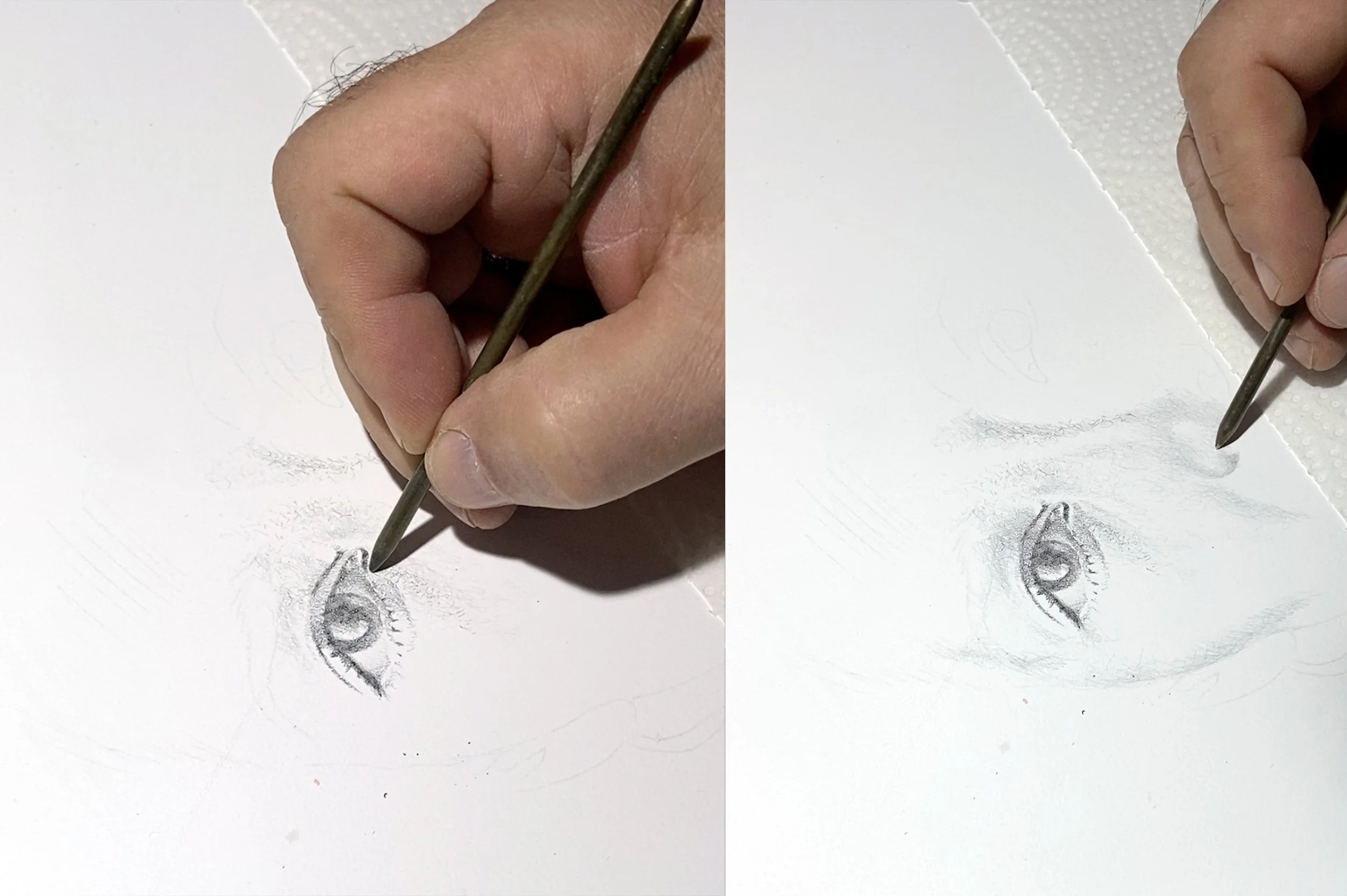
Note: Brasspoint on gessoed panel.
The drawing is made by abrasion, not pigment—metal worn into the surface. On this sealed, alkaline ground, the mark changes reluctantly, warming and dulling over time rather than corroding, its aging quiet and contingent.
The rod is actually a braising rod from my fathers wielding bench, sharpened and repurposed.