
Opening March 6th!
R[age is a gallery show that explores the tension between aging and identity, in a society obsessed with youth and technology. Inspired by Dylan Thomas’ poem Do Not Go Gentle into That Good Night, this exhibition challenges the notion that growing older means fading away. Instead, it celebrates the wisdom, defiance, and power that come with time.
This is more than an exhibition, it’s a conversation. A reckoning. A refusal to be erased.
Written in Dirt and Rust
Oil on Panel
152.4 cm (60 in) x 91.4 cm (36 in)
What does time leave behind, and how do you measure the strength that persists when everything else fades?
Time leaves its mark on everything it touches, on machines, on landscapes, on people. Written in Dirt and Rust is a reflection on endurance, on the strength that remains even as the years settle like dust. This excavator, once a force of power and precision, now stands weathered but unbroken, its history etched in the rusted metal and the earth it once moved.
There’s a quiet resilience in things built to last, a testament to the hands that guided them and the work they carried out. Even as decay sets in, memory holds fast. The past lingers in the worn steel, in the dirt pressed deep into every surface. This is not just a machine; it is a witness, a storyteller, a monument to effort and time.
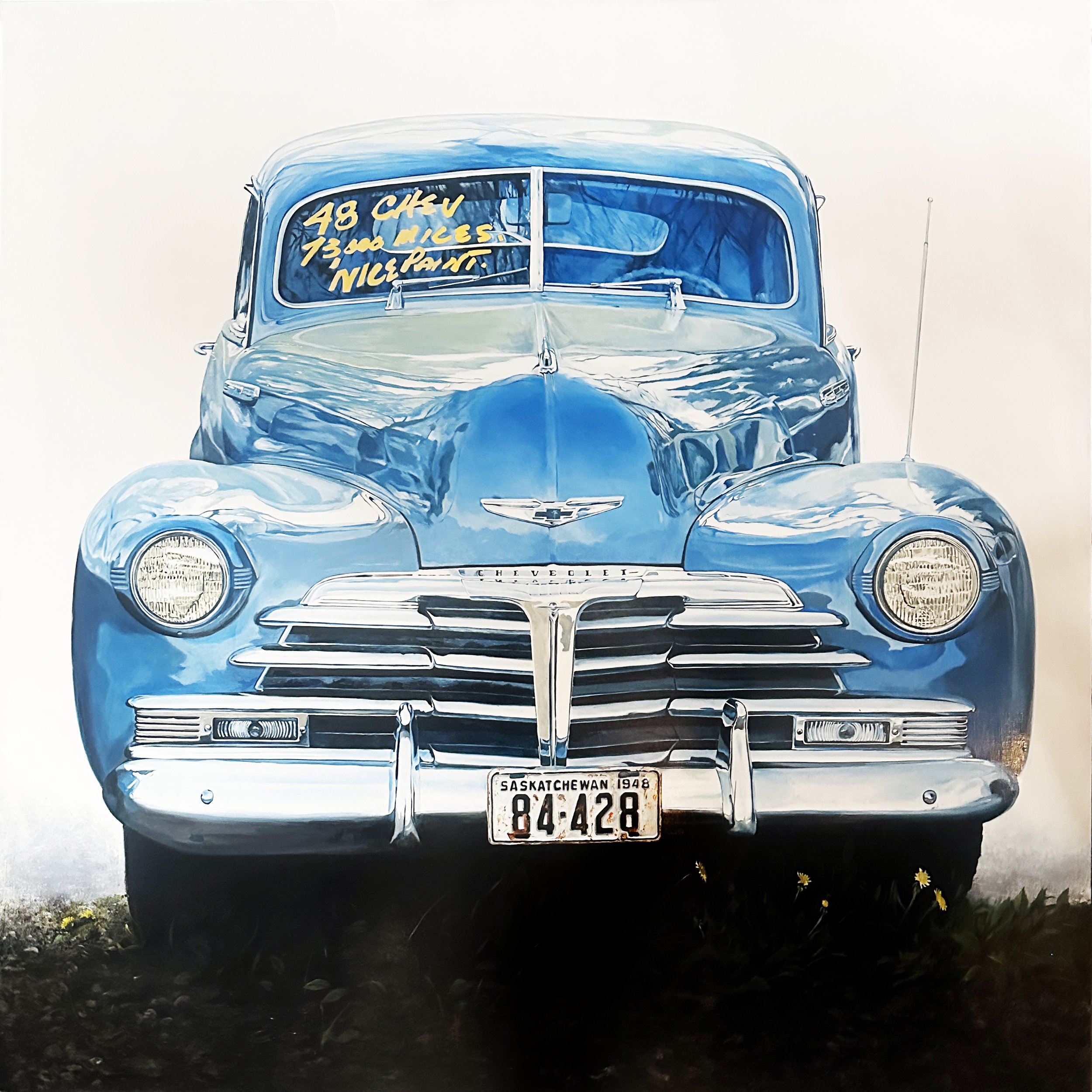
Nice Paint
Oil on panel
121.92 × 121.92 cm (48 x 48 in)
A polished surface bears a brief appraisal. Mileage reduced to shorthand. Condition summarized in two words.
The vehicle stands elevated by appearance, while the ground beneath records a slower measure, growth, encroachment, and time accumulating without concern for presentation.
The work holds the tension between surface and duration, between what is displayed and what is lived. A lifetime of movement is flattened into a transaction, its complexity absorbed by polish.
What remains unspoken continues beneath the shine.
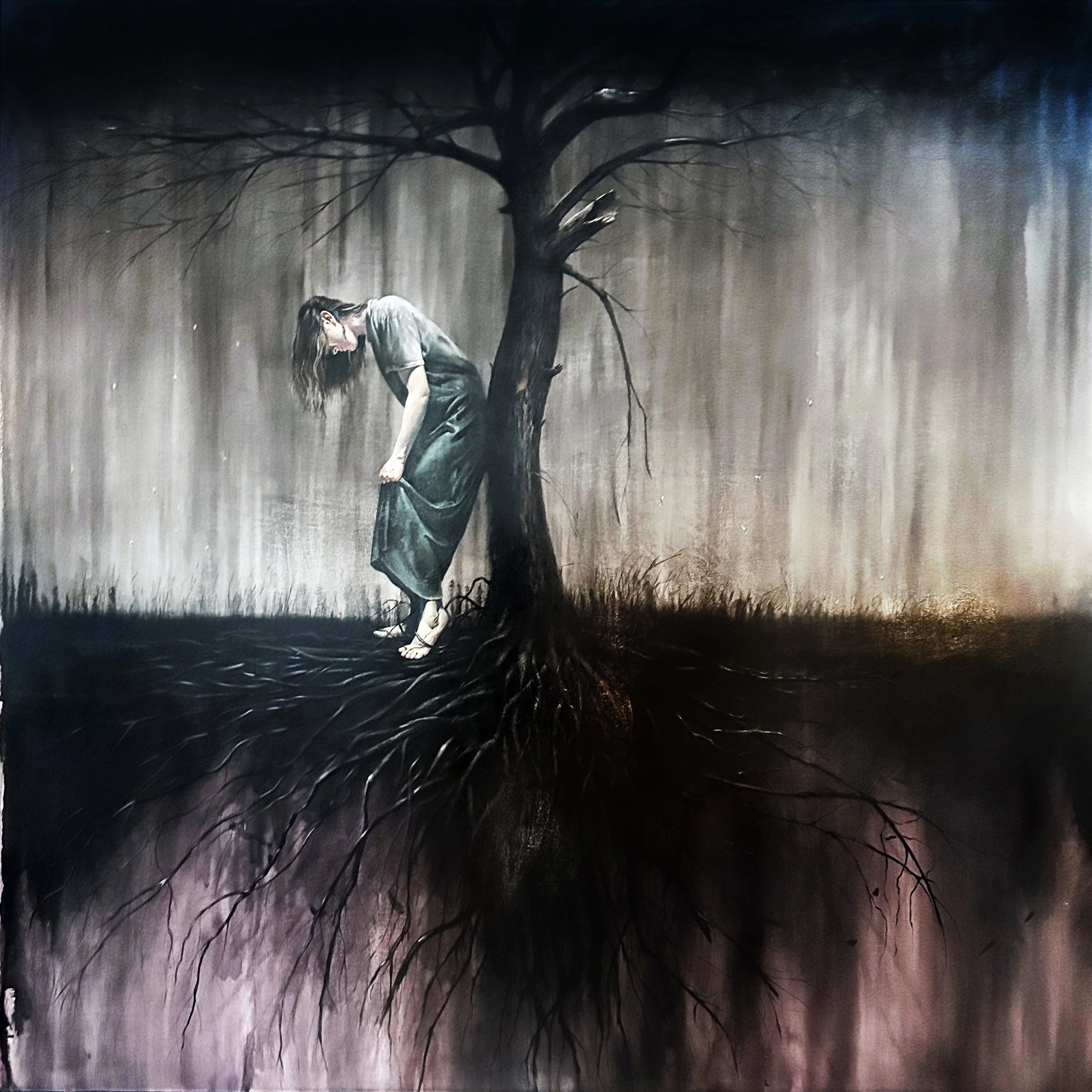
Tangle in Roots
Oil on panel
121.92 × 121.92 cm (48 x 48 in)
Bent toward the ground, the tree is both nourisher and claimant, its roots answering its branches. Wisps of wings lie at her feet. Nothing here leaves without returning. They settle back into the soil beneath the mirrored limbs.
Roots reach up.
Is it a caress, a longing, or something more needful?
Does the cycle carry intention, or only momentum?
The Wind’s Tithe (triptych) open


The Wind’s Tithe (triptych) closed
The Wind’s Tithe (triptych)
Oil on panel
243.84 × 121.92 cm (96 x 48 in)
Some processes unfold without a witness. They begin quietly, intensify briefly, and disperse without appeal.
Each panel records a stage held just long enough to be recognized, then released. Growth, flare, and dispersal proceed without negotiation. The wind does not pause. It does not recover what it takes.
This is not a sequence of loss, but of inevitability. What passes through the cycle does not return to its previous form.
What is retained here is the interval, the moment before separation becomes irreversible.
Waltz of Ashes
Oil on panel 121.92 cm (48 inches) X 121.92 cm (48 inches)
How long can you hold on to what’s slipping away, even when all that’s left is the memory of warmth?
Grief is not a clean break but a slow dissolution, an unraveling of the self into memory and longing. Waltz of Ashes captures the quiet devastation of loss, the way love does not simply end with death, but lingers, hollowing out the living. The figure clings to what remains, embracing absence as if it still holds warmth, stepping in time with the past, unwilling to let go.
This is not a dance of passion, but of sorrow. A final waltz with what once was, where dust and bone take the place of flesh, and love, enduring, desperate, refuses to fade.
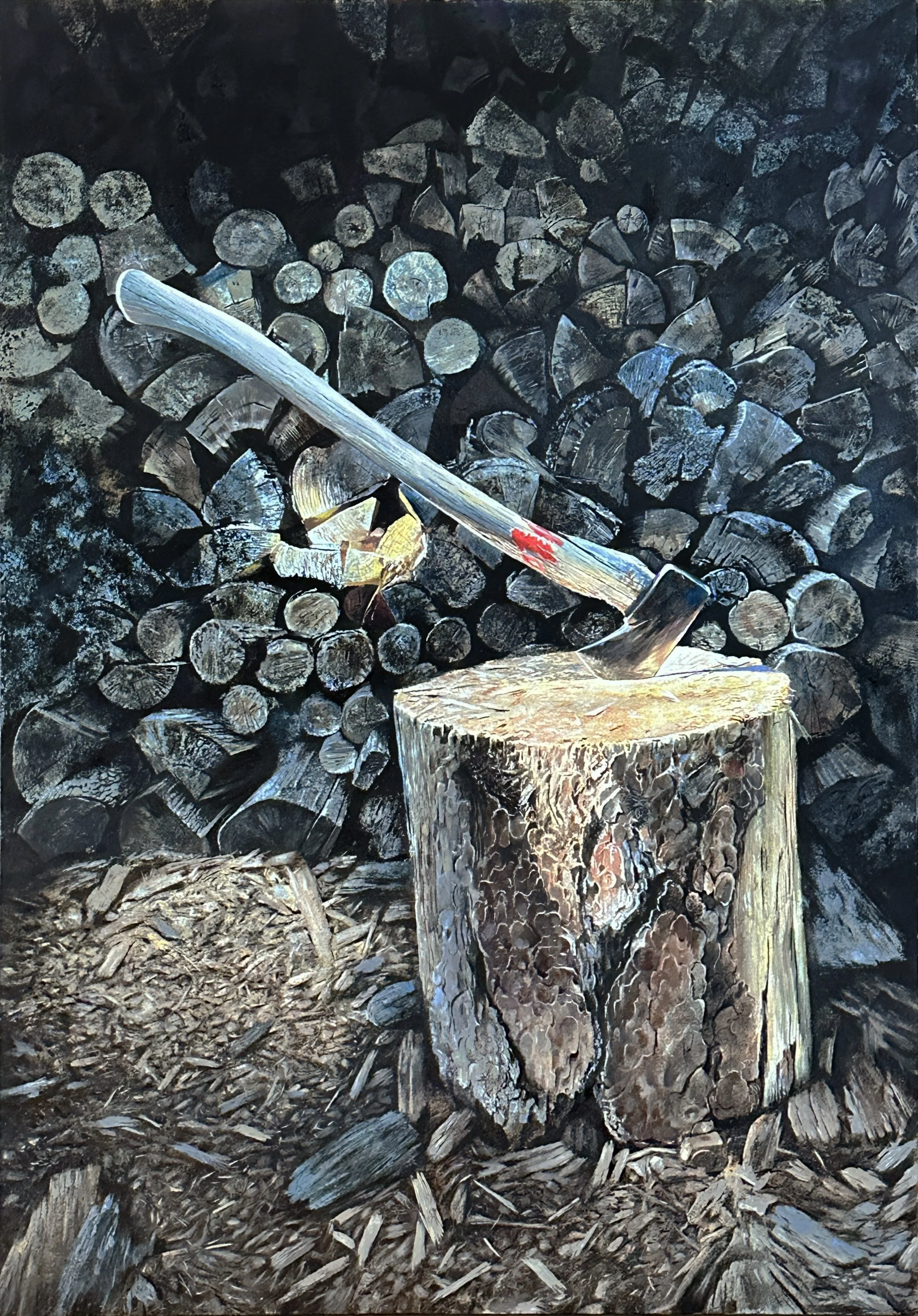
An Argument Against the Inevitable
Oil on panel
91.44 x 60.96 cm (36 x 24 in)
An old axe rests embedded in a stump, its handle split where force and time have met repeatedly. The flaw is visible, acknowledged, and ignored. Though dangerous to use, the tool remains in service, sustained by habit and the quiet belief that what has always worked will continue to do so.
The work considers persistence not as heroism, but as continuity practiced beyond reason. The axe is no longer an instrument of action alone; it becomes a record of deferred reckoning. Repair is possible, replacement is available, yet neither occurs. Instead, the object stands as evidence of an argument mounted against certainty itself, an insistence that function can outlast failure, and that the inevitable can be postponed through use.
In An Argument Against the Inevitable, resistance is not dramatic. It is ordinary, familiar, and quietly dangerous.
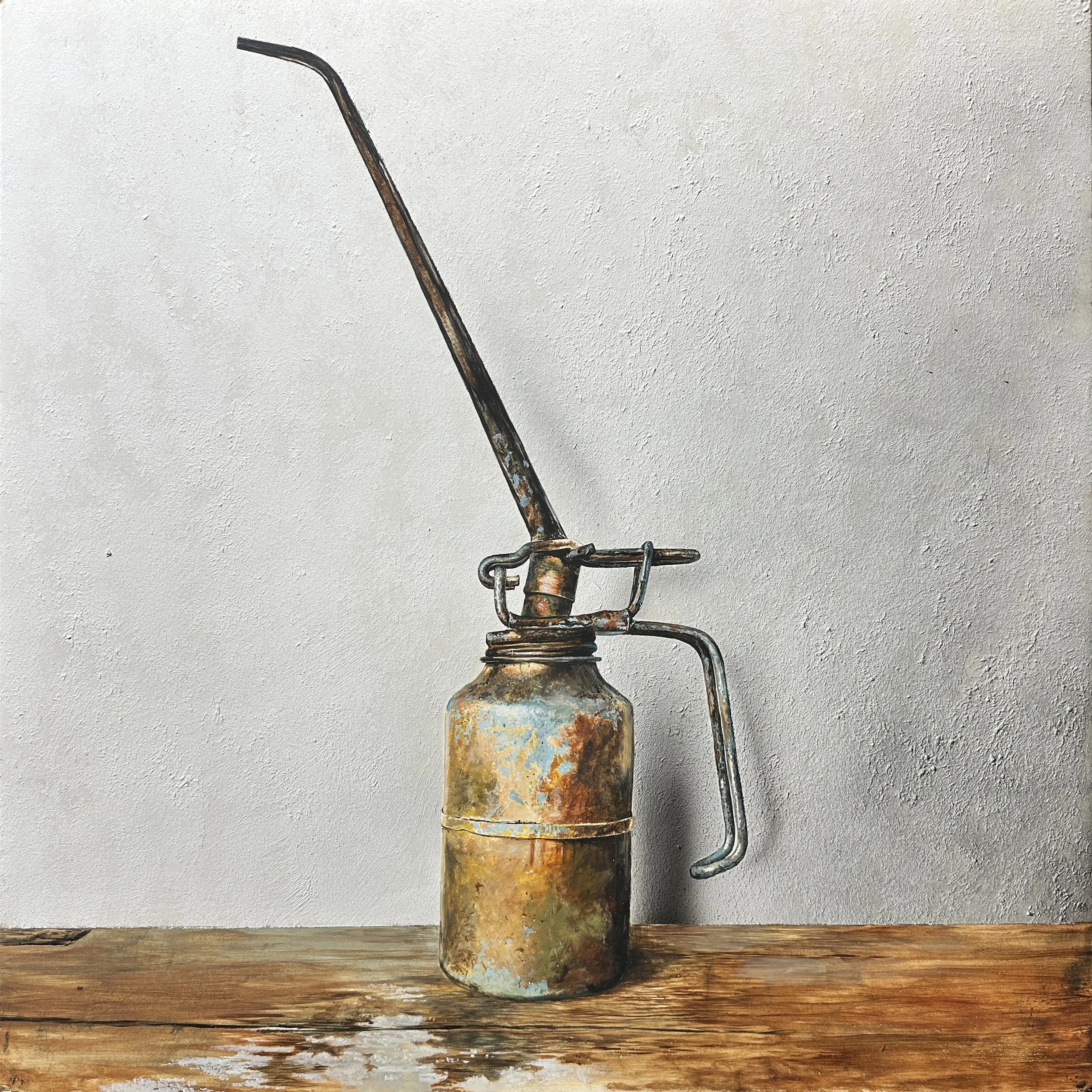
Worn in Service
Oil on panel
50.8 × 50.8 cm (20 × 20 in)
A vessel designed to interrupt friction.
To extend function.
To delay failure.
The spout is dry. The body retains only residue, dark and persistent. The object no longer performs its task, but it continues to register having done so.
What remains is not motion, but maintenance. A record of attention applied quietly, repeatedly, and without recognition.
The can endures beyond usefulness, holding evidence of service rendered one careful gesture at a time.

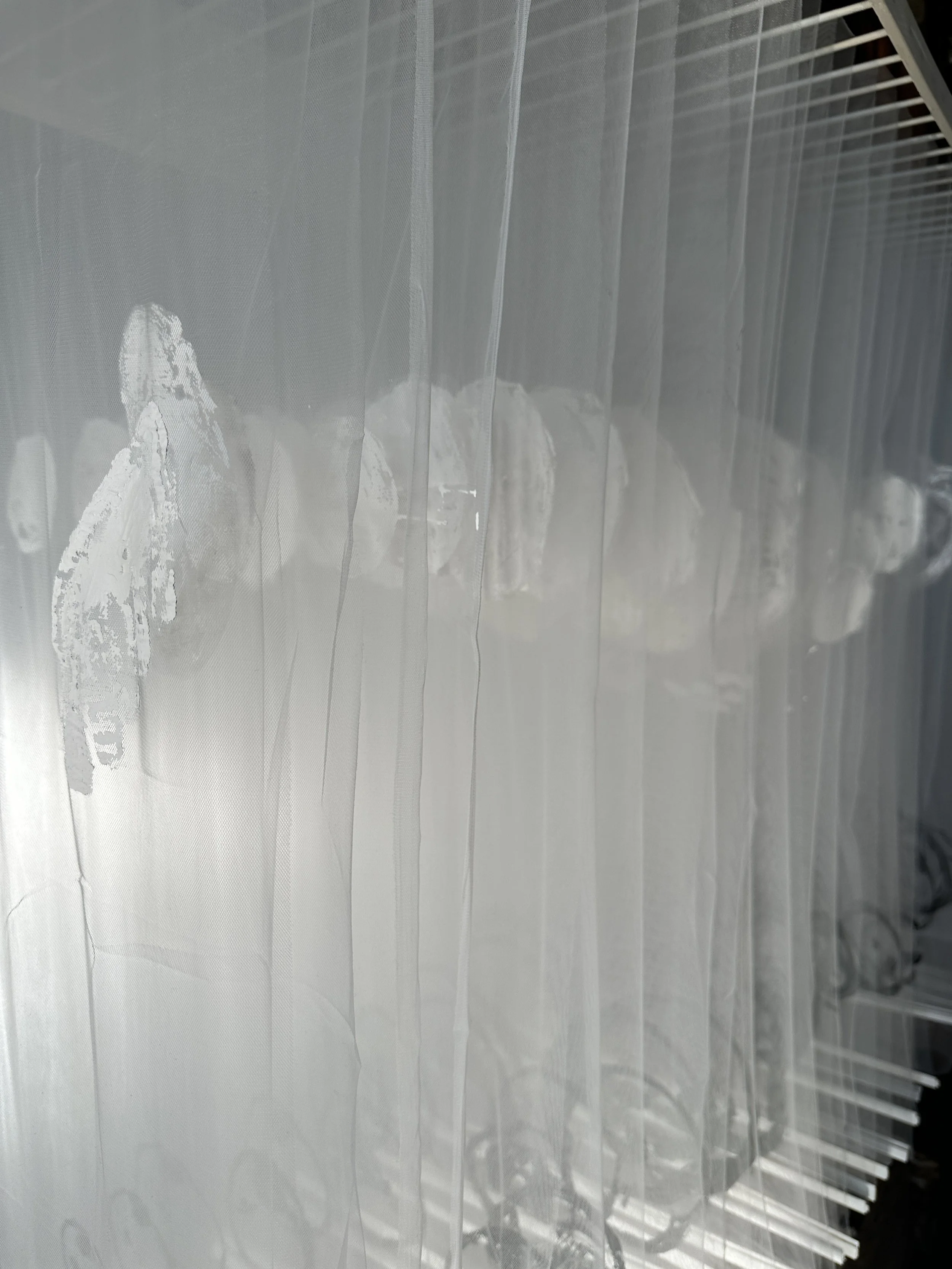
detail of top figure
FIG. 1, FIG.2
Chiffon, wood, dye, metal rods, resin, acrylic paint
243.84 cm (96 in) X 121.92 cm (48 in) x 86.36 cm (34 in)
What exists between presence and absence? How do you move when you are neither fully here nor gone? Two bodies hang in translucent silk, answering to air more than to weight. Above, a pale form that seems to belong to light. Below, it's darker counterpart that keeps close to the floor. They face, they do not meet. A draft unfastens them, turns figure to blur and back again.
The space between them holds the question, not the answer. Separation or return, farewell or descent, a pause that lengthens until it feels like a place. FIG. 1, FIG. 2 keep the body from settling into certainty. It lingers where gravity can be argued with, where memory can fail, where what remains is not quite form and not yet gone.
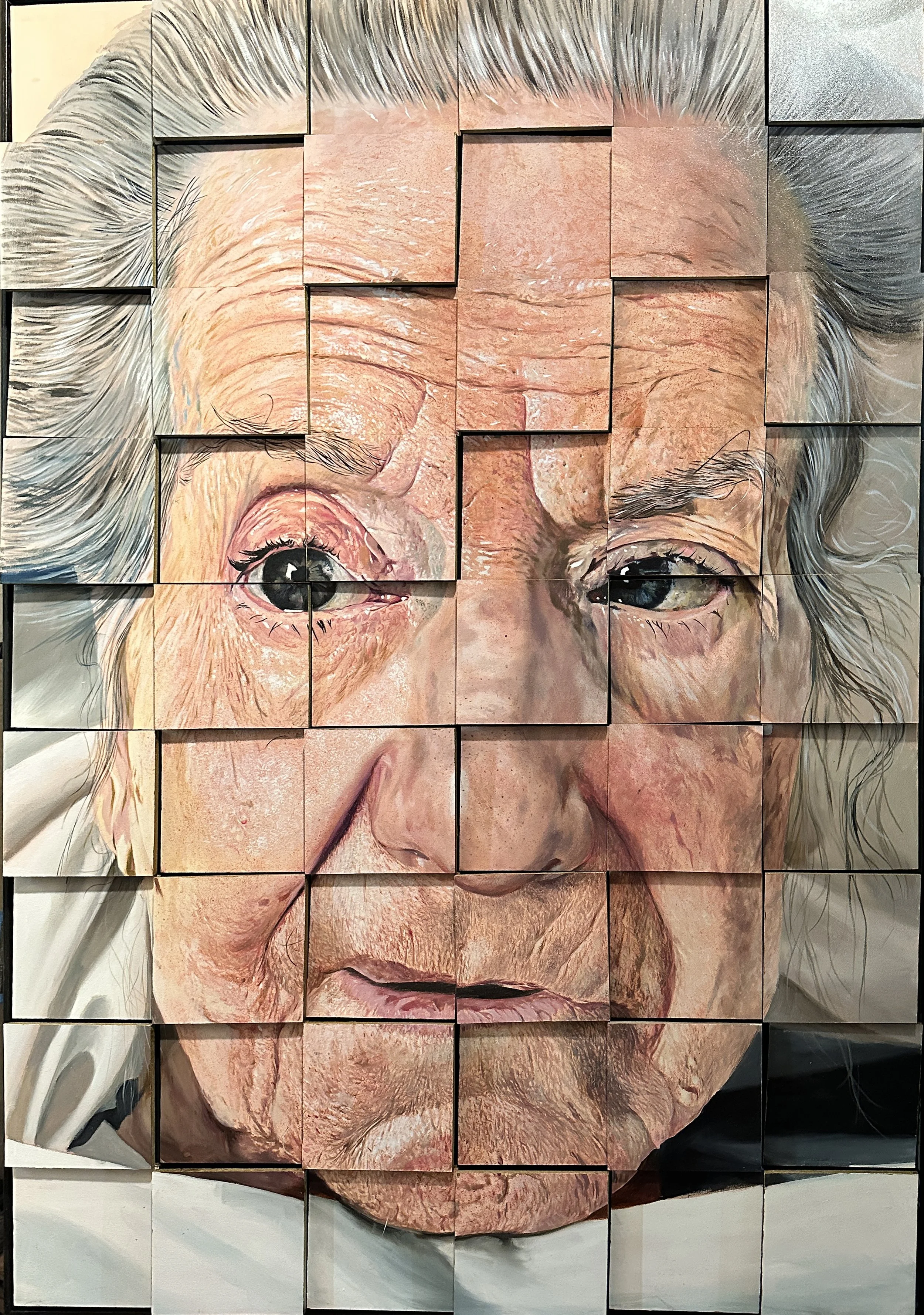
Remembering Her Forgetting
Oil on panel, gold leaf, skateboard bearings, electric motor
121.92 cm X 121.92 cm (48 x 48in)
A face assembles, disassembles, and assembles again. Each panel moves independently, never fully synchronized.
The image resolves briefly, then fractures. Recognition occurs as an event rather than a condition.
Once per cycle, the portrait becomes legible. Then the mechanism resumes.
The figure remains present throughout. What fails is not the body, but alignment.
Time here is mechanical, repetitive, and indifferent to recovery.
The system does not remember. It only repeats.
What is lost does not disappear at once. It leaves incrementally, through motion, delay, and misfire.
The person remains. The knowing recedes.
Remembering Her Forgetting attempts to visually document the slow loss of Lucy. As she slipped from us and her personality fractured, the absence accumulated. What was lost did not vanish all at once; it left gradually, repeatedly, and with slow finality.


The unimaginable idea of birth in the mind of the dead
Resin, wood
30.48 cm (12 in) x 21.59 cm (8.5 in) x 20.32 cm (8 in)
What is born from the place where life ends?
How thin is the boundary between creation and decay?
Within the translucent skull, a blue form hovers, fragile and luminous, yet unresolved. Death’s vessel becomes a cradle, holding the echo of beginnings within its permanence.
The resin makes porous what we think solid: birth and death, presence and absence, creation and dissolution collapse into one. Here, the end does not silence but germinates, making space for the possibility of return.
The skull becomes both reliquary and womb, a reminder that the cycle of existence is never singular, each ending carrying within it the seed of what comes next.


The view from here
Resin, acrylic, vintage photos, wood
22.86 cm (9 in) x 21.59 cm (8.5 in) x 38.1 cm (15 in)
What remains when memory distorts?
Why is there solace in what you cannot hold?
Within the translucent cast, fragments of the past drift, blurred and partial. They hover above the weight of stone, a fragile vision fixed toward what cannot be avoided.
The resin preserves yet warps, catching pieces of lives already receding. The rod steadies that gaze, thin and almost unseen, a tenuous tether between what endures and what ends.
Finality waits, inevitable and still. Memory lingers, imperfect and shifting, fragile yet insistent. Between them lies the contradiction, solace in what slips away, terror in what cannot.


…and we all fall
Resin, acrylic, vintage photos, wood
30.48 cm (12 in) x 21.59 cm (8.5 in) x 38.1 cm (15 in)
What is left behind when memory and identity dissolve?
“…and we all fall” explores the liminal space between memory, identity, and mortality. The suspended resin face, embedded with fragments of aged photographs, embodies the spectral persistence of lineage, simultaneously revealing and concealing the imprint of generational memory. Beneath the weight of the concrete slab, reminiscent of a tombstone, anchors the ephemeral in stark materiality, grounding the transient echoes of the past in the inevitability of physical decline. The slender acrylic rod, barely perceptible, serves as a fragile conduit between realms, evoking the delicate tension that threads existence to remembrance. In its interplay of transparency and mass, presence and absence, the work contemplates the precarity of legacy, inviting reflection on the slow dissolution of identity into the foundations of collective memory.


Fig 027-A (Young) Fig 027-B (Aged) Subject: Racheal
silk, cyanotype, silver point, graphite, acrylic paint, wood
35.56 cm (14 in) x 35.56 cm (14 in)
How old are you inside?
How do we reconcile the aging body with the unchanging sense of self, and how are we shaped by the judgments of others?
These works explore the intersection of biology and perception, exposing how society reframes aging not as an inevitability, but as a failure. The body alters, skin loosens, features shift, yet the heavier weight comes from the gaze of others. Age is no longer a process to be lived, but a condition to be treated, optimized, or hidden, a problem to be solved.
The layered portraits confront that tension. The younger self, rendered in silverpoint and graphite, speaks with immediacy, anchored in the present. Suspended above, the aged self emerges in cyanotype, drifting like a memory or a warning, marked by time but edged with exile. The space between them is not only temporal but ideological: a gap where expectation, responsibility, and shame collide.
Inside, however, the self resists change. We persist in our continuity, even as the body transforms beyond recognition. The mirror shocks not because we do not expect to age, but because the reflection feels misaligned with the inner life that remains unfinished, unaged.
We all age. Yet society insists some do it better than others. But better for whom, and at what cost?


Fig 038-A (Young) Fig 038-B (Aged) subject: John
silk, cyanotype, silver point, graphite, acrylic paint, wood
35.56 cm (14 in) x 35.56 cm (14 in)
“Beneath the bone, a name unspoken. Beneath the name, a spell not yet broken.”


Firelight and Shadow,
A Reliquary for Unquiet Things
21.59cm (8.5 in) x 15.24 (6 in) with lectern 132.08 cm (52 in) X 25.4 cm (10in) X 45.72 cm (18 in)
Altered Book, paper, ink, resin, oil paint, acrylic paint, wood
The sightless witness is sealed within a reliquary, locked in refusal at the hollowed core of a book. Cast in resin, the crow skull is surrounded by scattered remnants, ash from the removed pages, their words forever silenced. Beneath the skull is embedded a text drawn from imagined scripture and scorched myth, speaking to what burns inward: rage, memory, refusal.
The skull does not scream, but watches. The pages do not speak, but hold. What could not rest, could not yield, remains.
A monument to the fire that endures beneath stillness, preserving what the world tries to bury: grief, fury, and the fragile trace of flight.
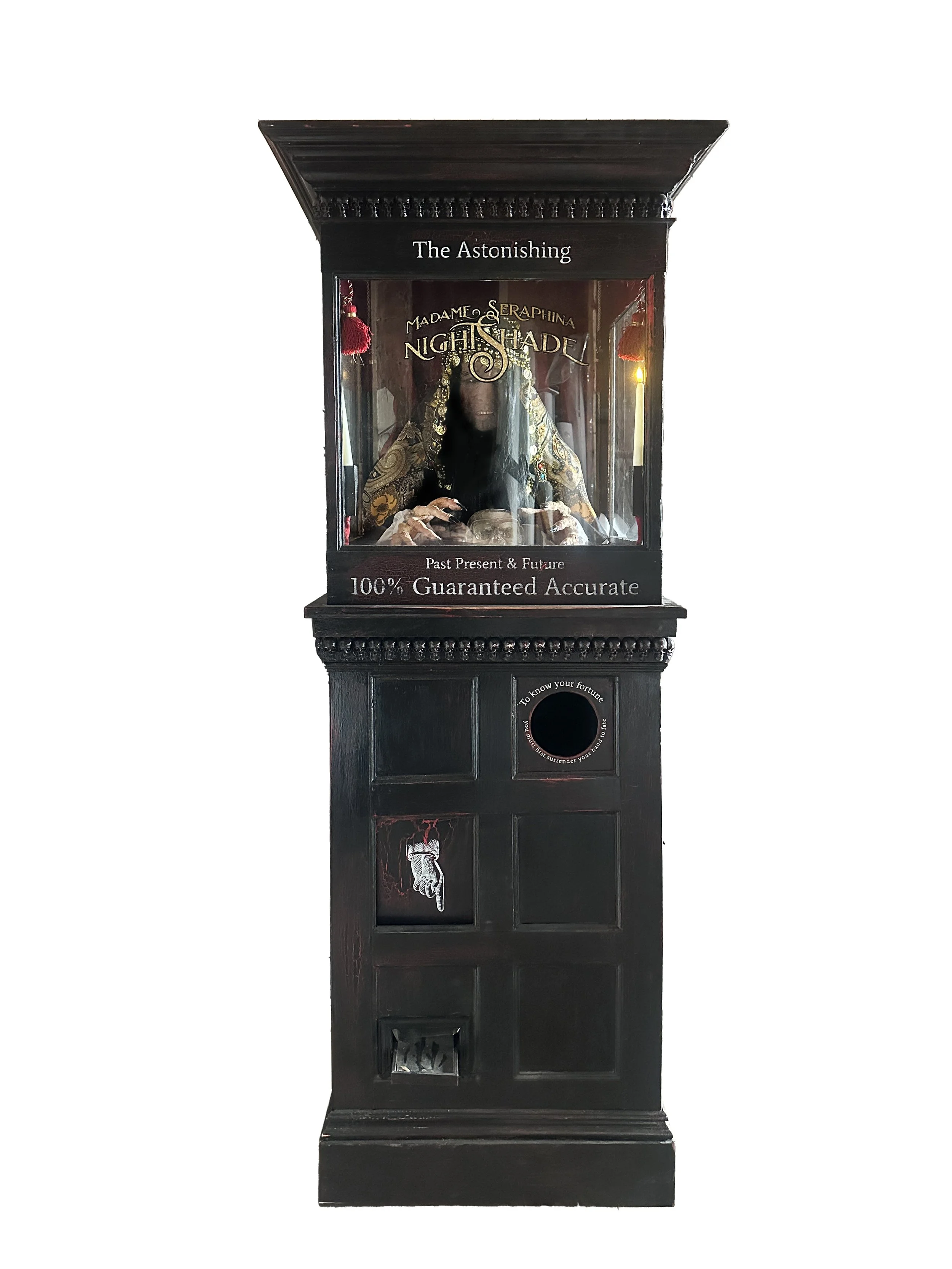
Madame Seraphina Nightshade
Mixed media installation
181.102 H x 54.61 D x 60.96 W (71.3h x 21.5d x 24w in)
This is your future
It is everyone and everything’s future
For the living must die
What do you see when the past stares back at you, and how do you face the inevitable when it’s presented as a cold truth?
A relic of bygone carnivals, Madame Seraphina stands as a specter from a forgotten era. Her animated gaze offers not fortune but a cold reminder of the inescapable fate shared by all. As visitors approach, her head tilts and swivels, eyes darting with a lifelike eeriness, and her mouth opens and closes, offering a glimpse into the mechanical soul within. With each movement, she draws the viewer deeper into her unsettling presence.
The card, bearing only this stark truth, links the viewer to an impersonal finality, ushered forward by the whir of her mechanical limbs. Beneath the veneer of the old-time carnival aesthetic, Madame Seraphina invites a confrontation with mortality. Her face, sculpted in silicone, remains frozen in a timeless expression, reflecting the silent inevitability that looms over us all. The QR code on the reverse side connects to her cryptic, digital presence, further emphasizing the stark dichotomy between the physical and virtual, between the human and the mechanical.
In this interactive piece, the viewer is not simply an observer but a participant in a fleeting moment of engagement with fate. Madame Seraphina’s message is not one of comfort, but of a reminder, delivered in the chilling embrace of nostalgia, that all things come to an end.
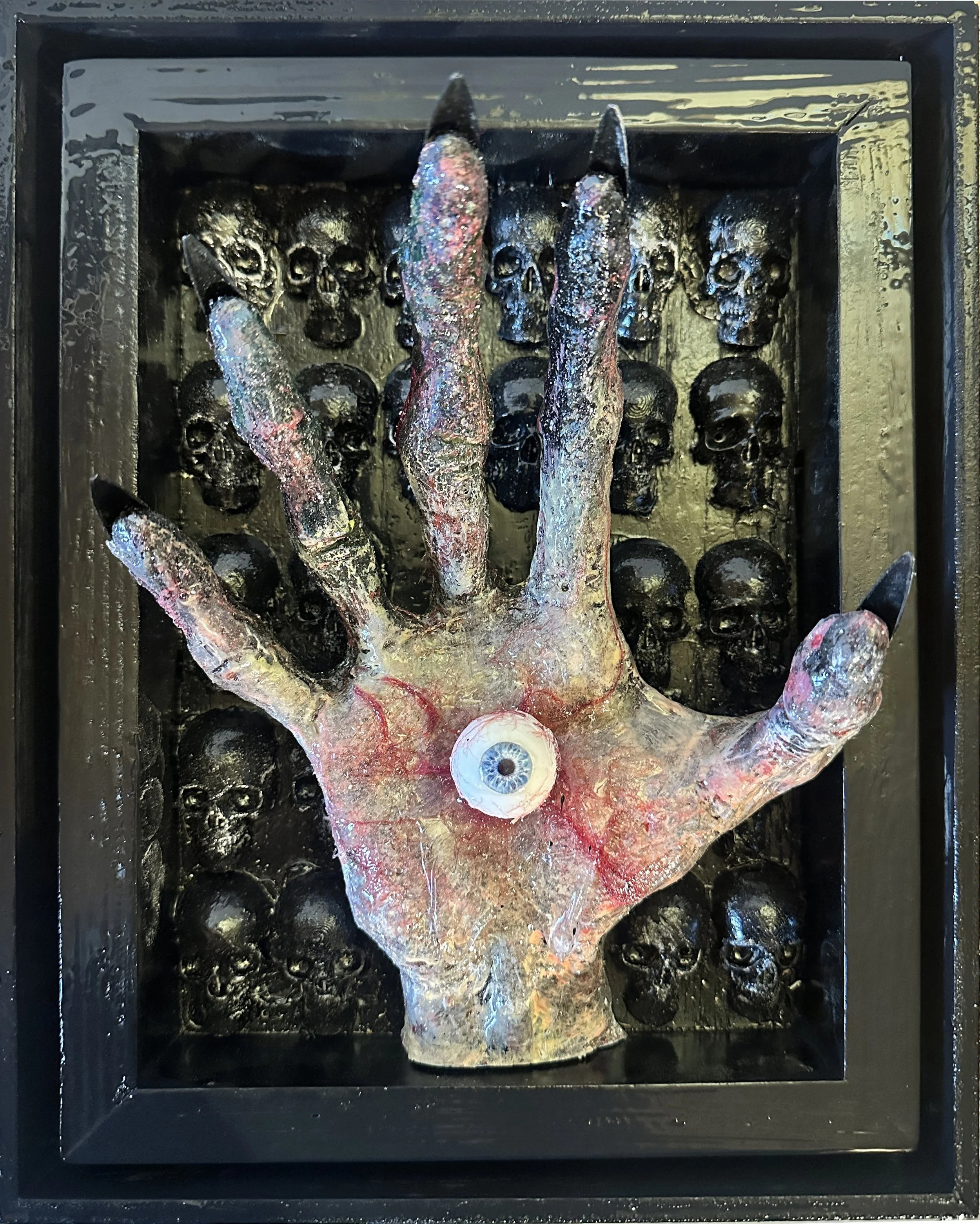
The Last Fortune Told
Mixed media assemblage
Approx. 20.3 × 25.4 cm (8 × 10 in)
This object is composed of remnants of an earlier work, a hand and an eye left over from the construction of an oracle that no longer speaks. Cast at life scale and mounted over a field of skulls, it holds the residue of a final function, a body part that once extracted meaning, now reduced to a relic.
Embedded in the palm, the eye no longer predicts or answers. It remains only as a witness. The gesture is not one of offering or warning, but of remainder, what is left after purpose expires.
The Last Fortune Told marks the end of a divinatory cycle. It does not foretell what comes next. It records the moment when the machinery of prophecy finishes its last task and falls silent.