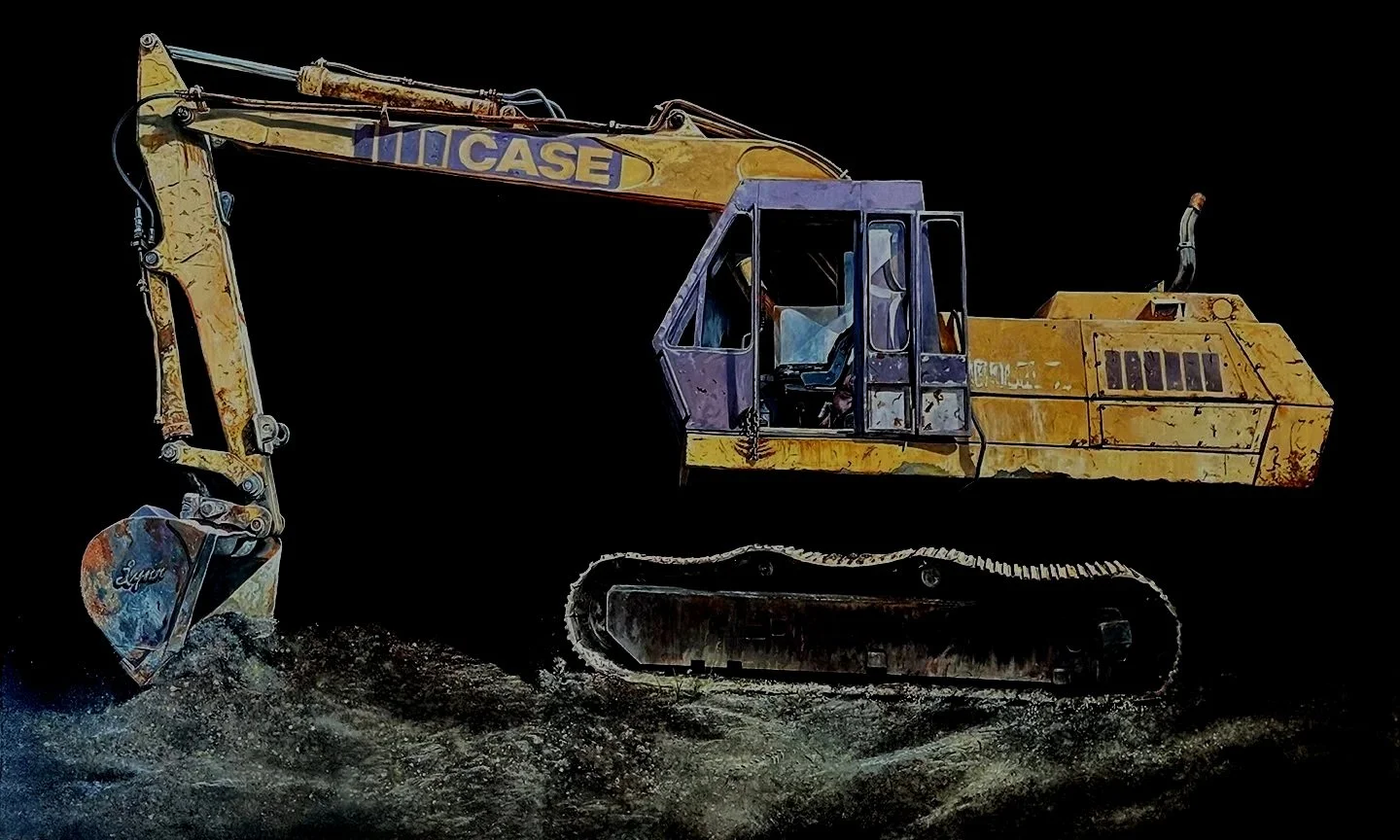
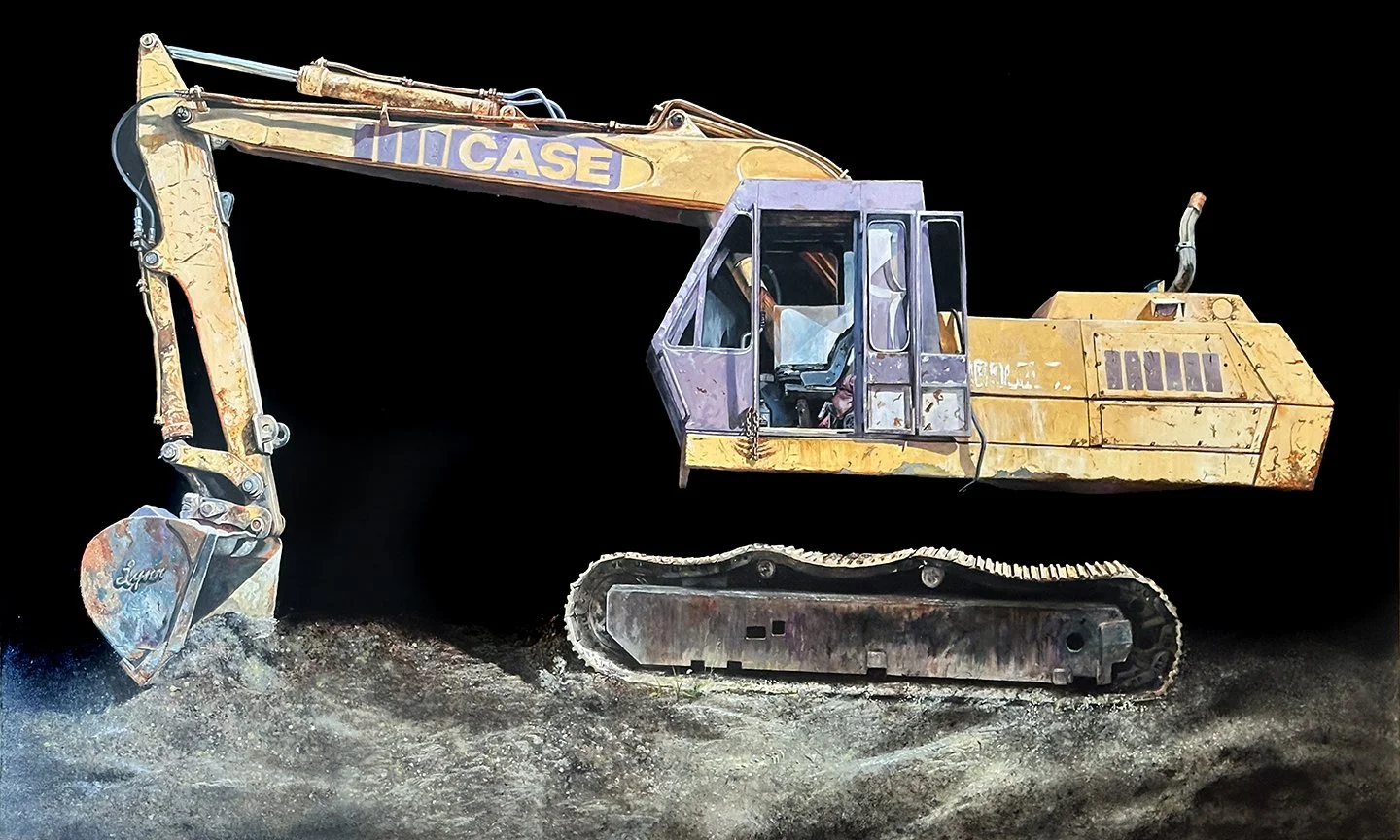
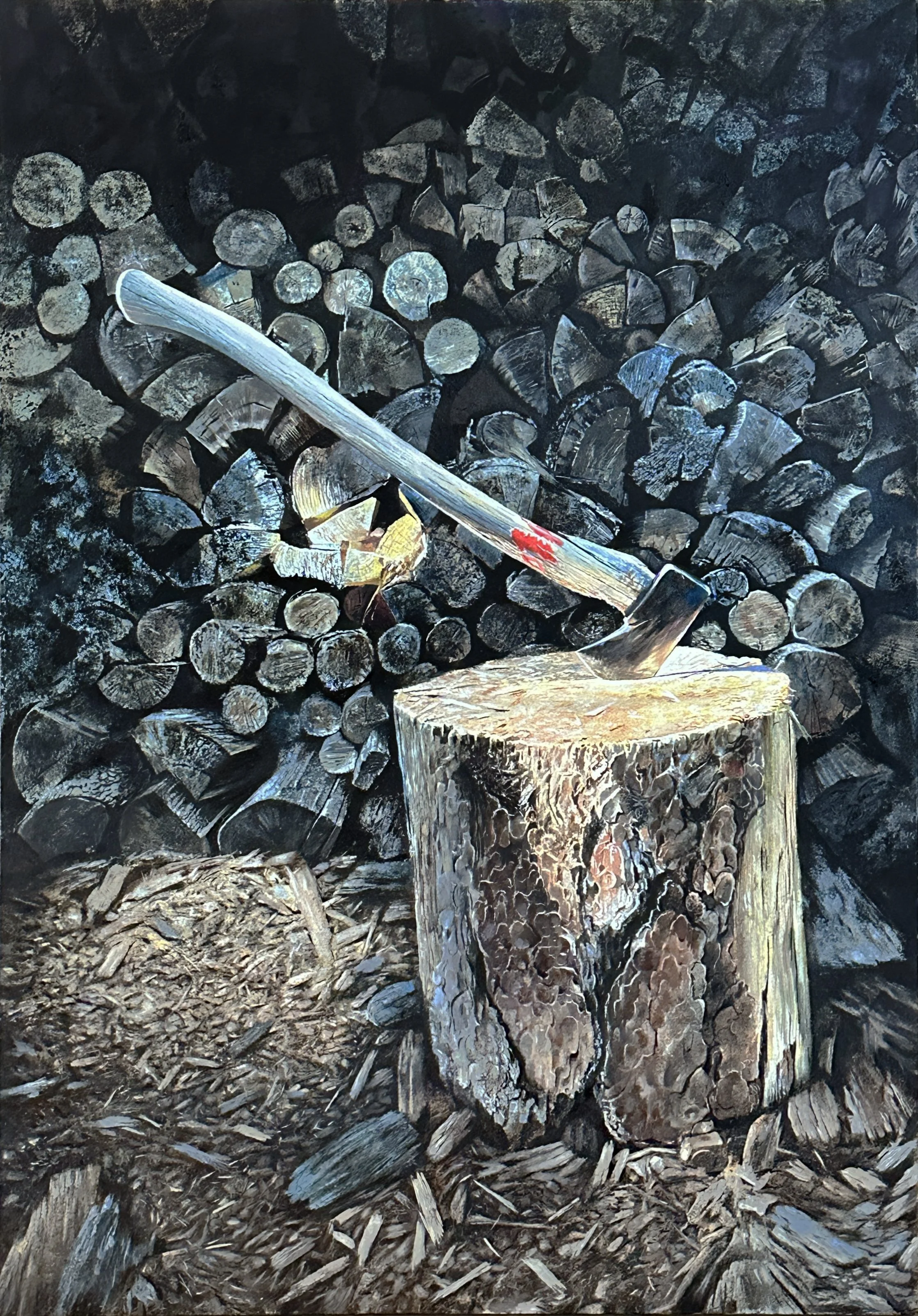
Written in Dirt and Rust
Oil on cradled wood panel, framed in a shadowbox frame
152.4 × 91.44 cm (60 x 36 in)
A machine rests after its task has ended. Its form carries the compression of labor, the accumulation of contact with the ground, and the load.
Paint peels. Metal oxidizes. Dirt embeds itself into every joint. These marks do not indicate failure, but duration, the evidence of sustained use rather than collapse.
The object no longer moves earth, yet it continues to register having done so.
Its presence is not commemorative.
It remains as a record of effort once applied and no longer required.
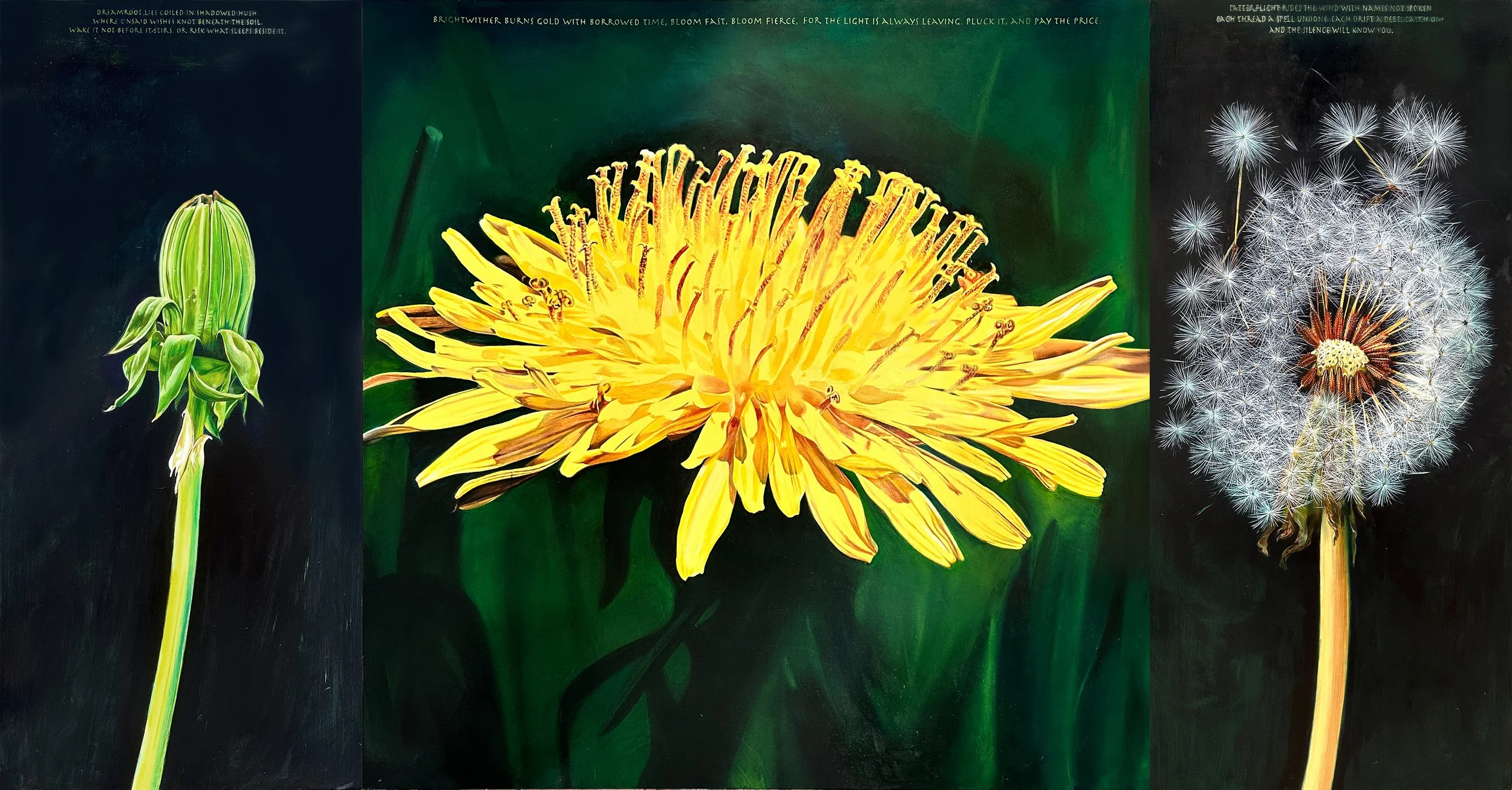
The Wind’s Tithe (triptych)
Oil on three hinged cradled wood panels
243.84 × 121.92 cm (96 x 48 in)
Some processes unfold without a witness. They begin quietly, intensify briefly, and disperse without appeal.
Each panel records a stage held just long enough to be recognized, then released. Growth, flare, and dispersal proceed without negotiation. The wind does not pause. It does not recover what it takes.
This is not a sequence of loss, but of inevitability. What passes through the cycle does not return to its previous form.
What is retained here is the interval, the moment before separation becomes irreversible.
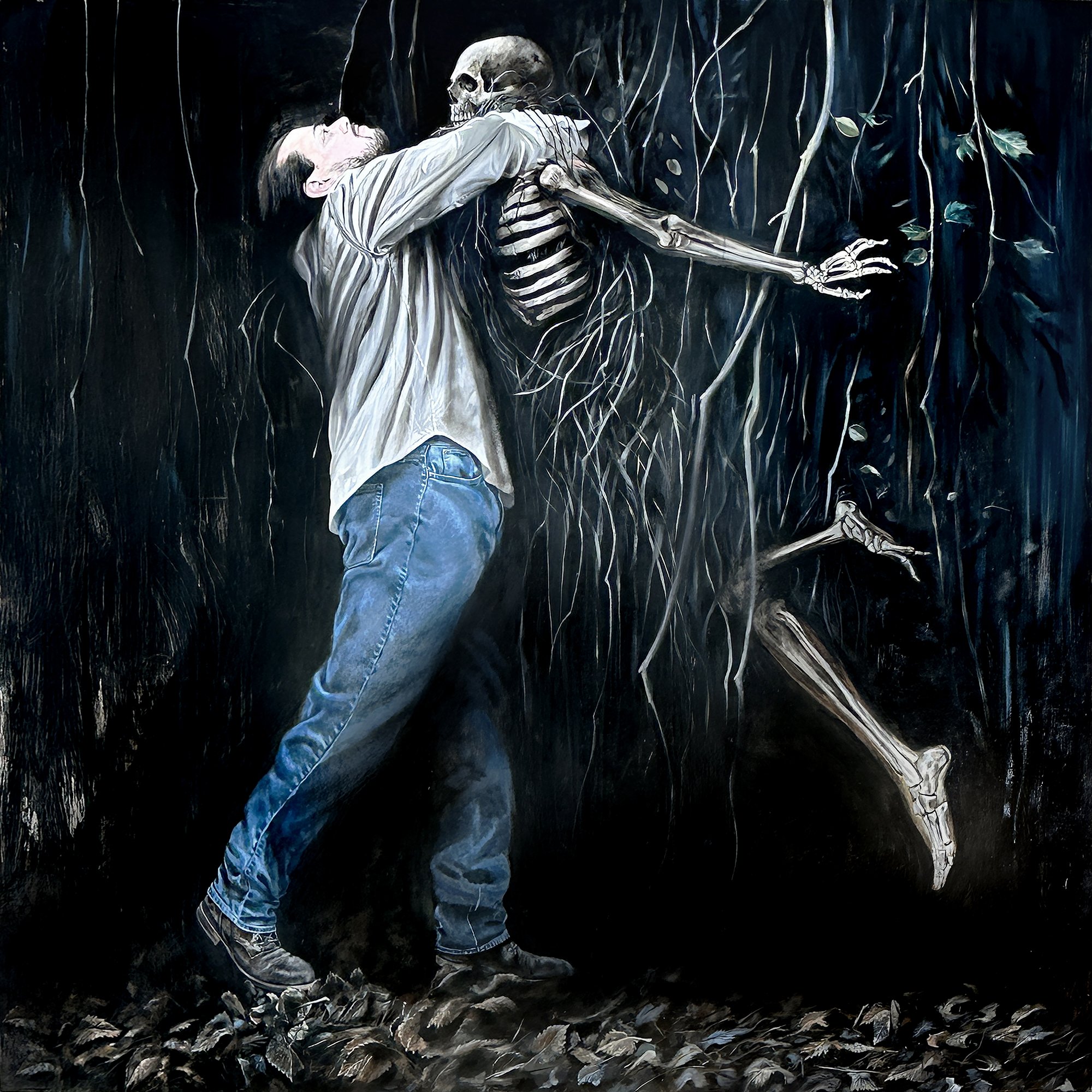
Waltz of Ashes
Oil on cradled wood panel, framed in a shadowbox frame
121.92 × 121.92 cm (48 x 48 in)
An embrace is maintained after its counterpart has already vanished. What remains is posture, pressure, and the memory of weight.
Bone replaces flesh. The body leans anyway.
This is not a movement toward something new, but the continuation of a gesture whose purpose has already passed. The figure persists in time with what is no longer present, maintaining the form of intimacy after its function has ended.
What is recorded here is duration. The moment when holding becomes the act itself.
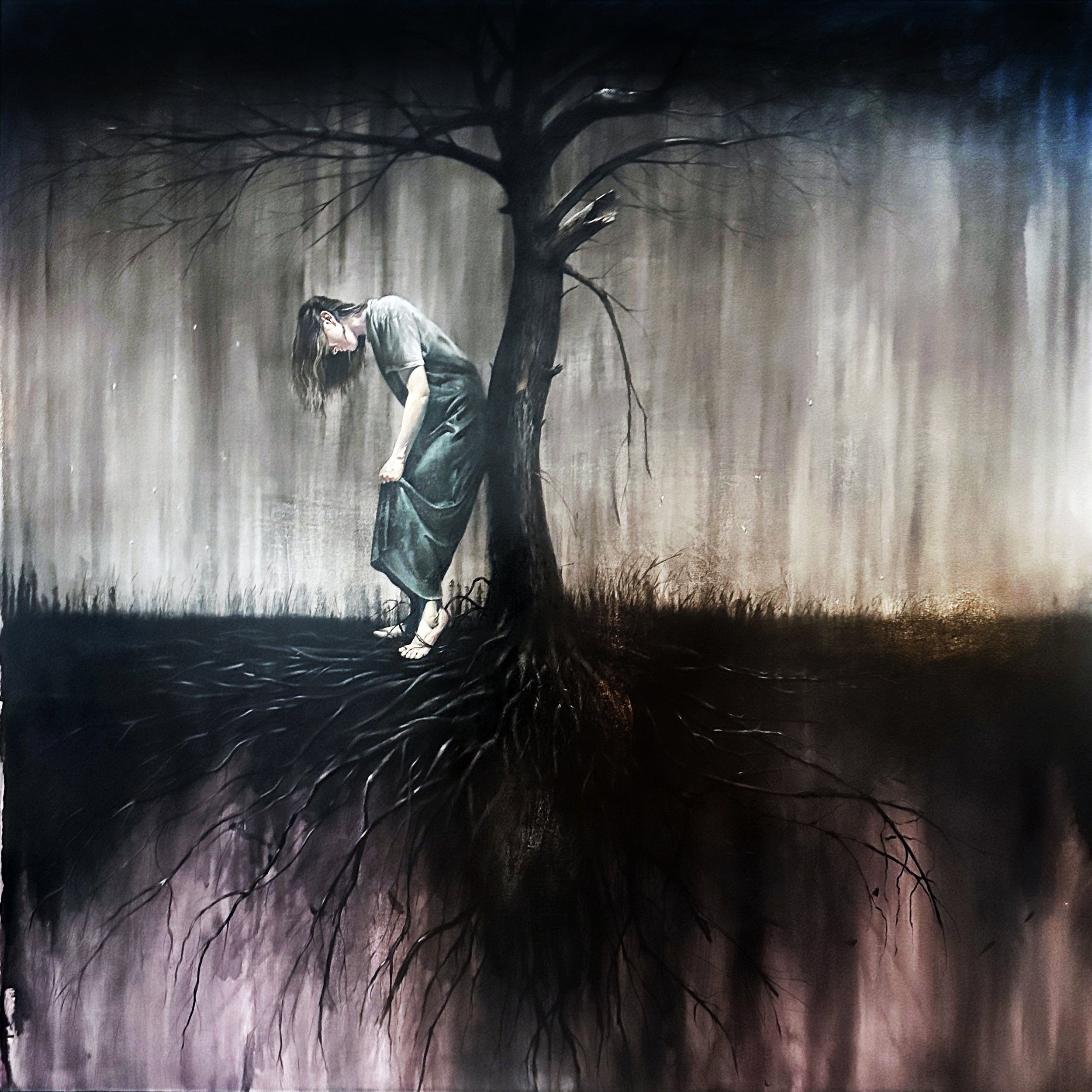
Tangle in Roots
Oil on cradled wood panel, framed in a shadowbox frame
121.92 × 121.92 cm (48 x 48 in)
Moth wings break into dust before they reach the soil.
There is no distinction between a quiet breath and the last flight of a moth.
Roots gather, not in cruelty,
not in kindness.
Nothing here hesitates.
The system continues.
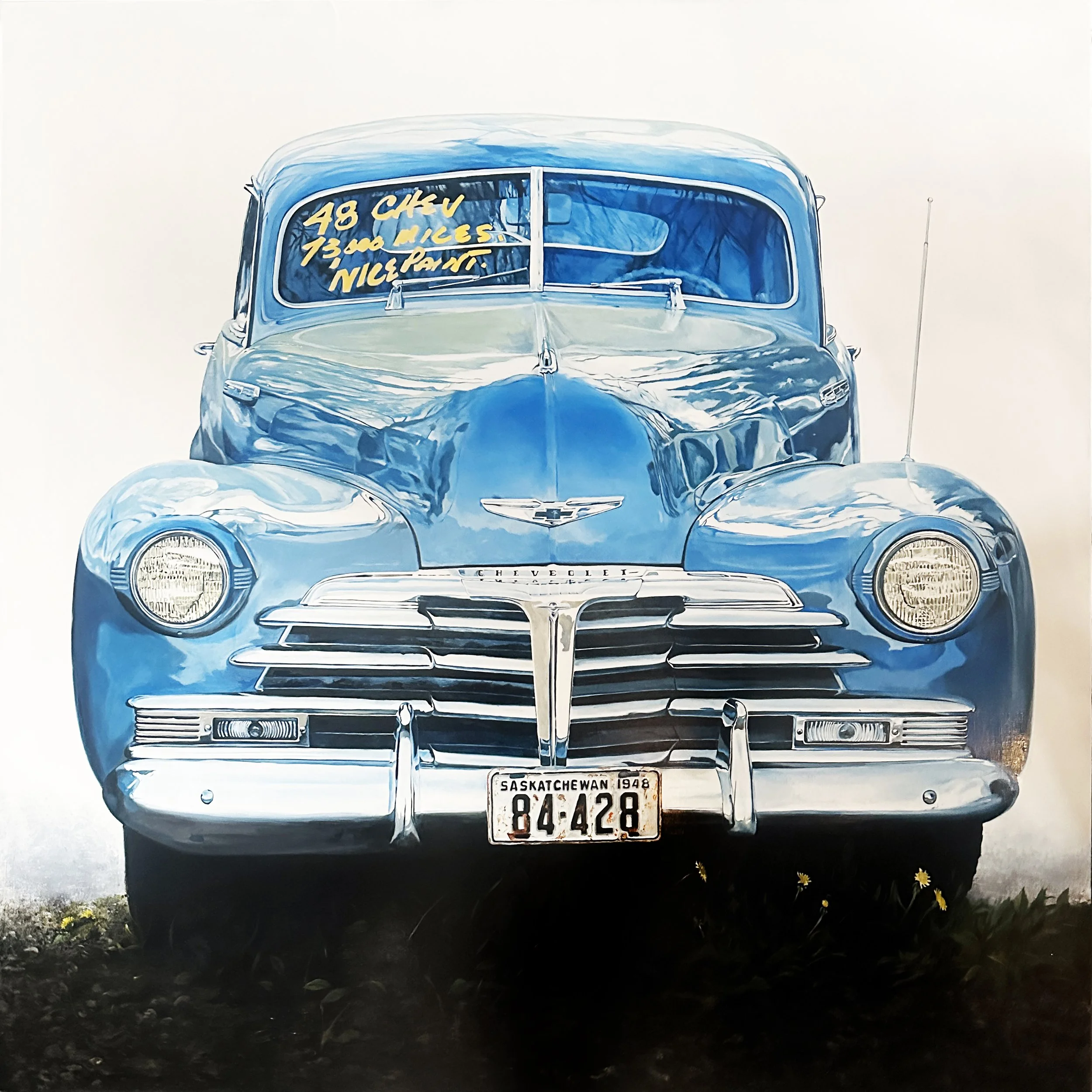
Nice Paint
Oil on cradled wood panel, framed in a shadowbox frame
121.92 × 121.92 cm (48 x 48 in)
A polished surface bears a brief appraisal. Mileage reduced to shorthand. Condition summarized in two words.
The vehicle stands elevated by appearance, while the ground beneath records a slower measure, growth, encroachment, and time accumulating without concern for presentation.
The work holds the tension between surface and duration, between what is displayed and what is lived. A lifetime of movement is flattened into a transaction, its complexity absorbed by polish.
What remains unspoken continues beneath the shine.
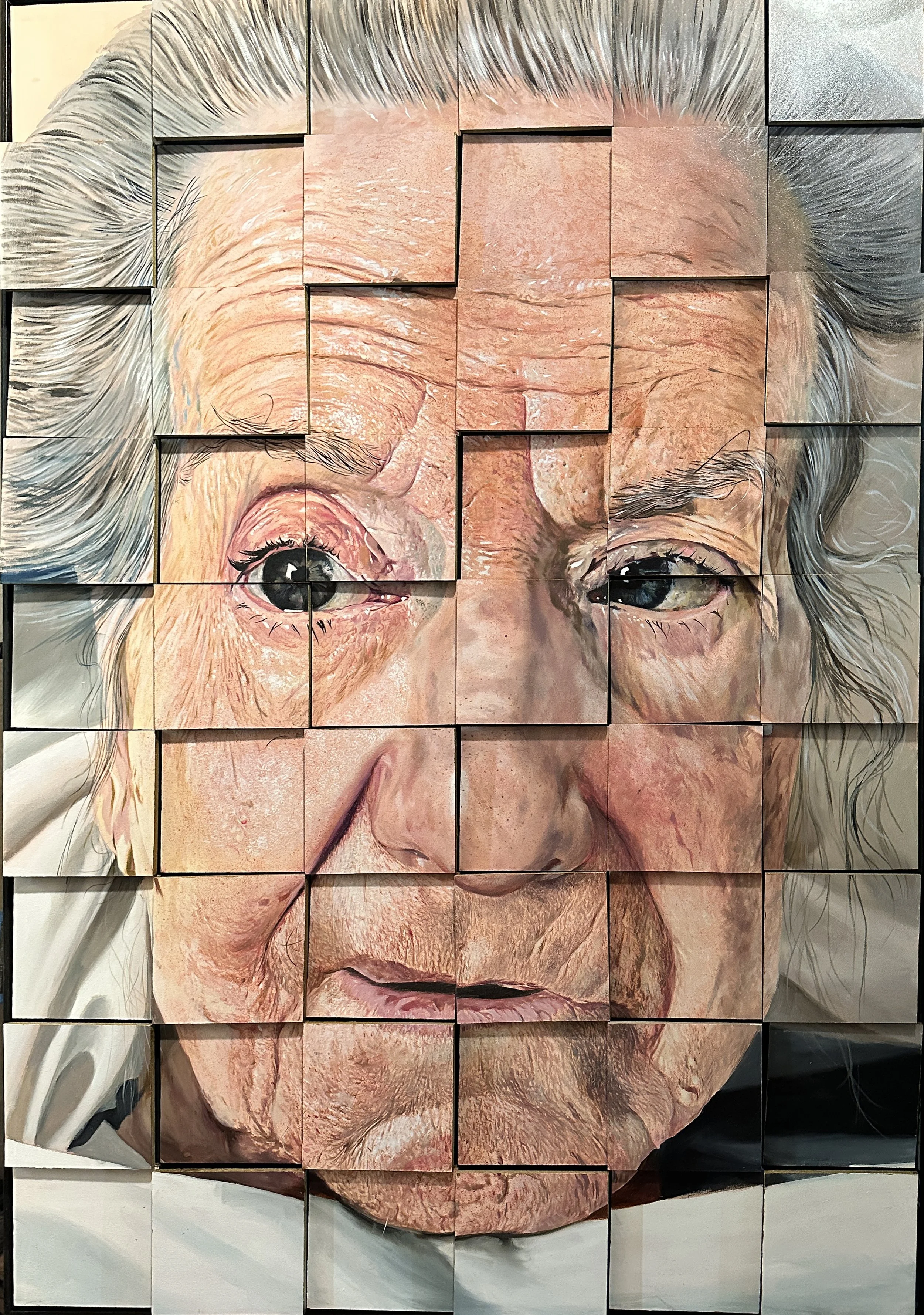
Remembering Her Forgetting
Oil on panel, gold leaf, skateboard bearings, 3 electric motors, drive belts, and wood
83.82 X 127 cm (33 x 50in) Cabinet 203.2 X 96.52 X 25.4 cm (80 x 38 x 10 in)
In collaboration with Justin Ramsden
A face assembles, disassembles, and assembles again. Each panel moves independently, never fully synchronized.
The image resolves briefly, then fractures. Recognition occurs as an event rather than a condition.
Once per cycle, the portrait becomes legible. Then the mechanism resumes.
The figure remains present throughout. What fails is not the body, but alignment.
Time here is mechanical, repetitive, and indifferent to recovery.
The system does not remember. It only repeats.
What is lost does not disappear at once. It leaves incrementally, through motion, delay, and misfire.
The person remains. The knowing recedes.
Remembering Her Forgetting attempts to visually document the slow loss of Lucy. As she slipped from us and her personality fractured, the absence accumulated. What was lost did not vanish all at once; it left gradually, repeatedly, and with slow finality.
The portrait is composed of 320 custom-designed, 3D printed components and 162 precision bearings, a fully engineered mechanical architecture concealed behind paint.
It's 54 panels rotate on 54 unique gear ratios, dispersing the image into a complex, non-repeating field of fragments before returning to imperfect alignment.
If driven forward continuously, the system would require a timespan vastly exceeding the age of the universe to naturally return to the same configuration.
The diffusion is not accidental.
It is mathematically non-repeating.
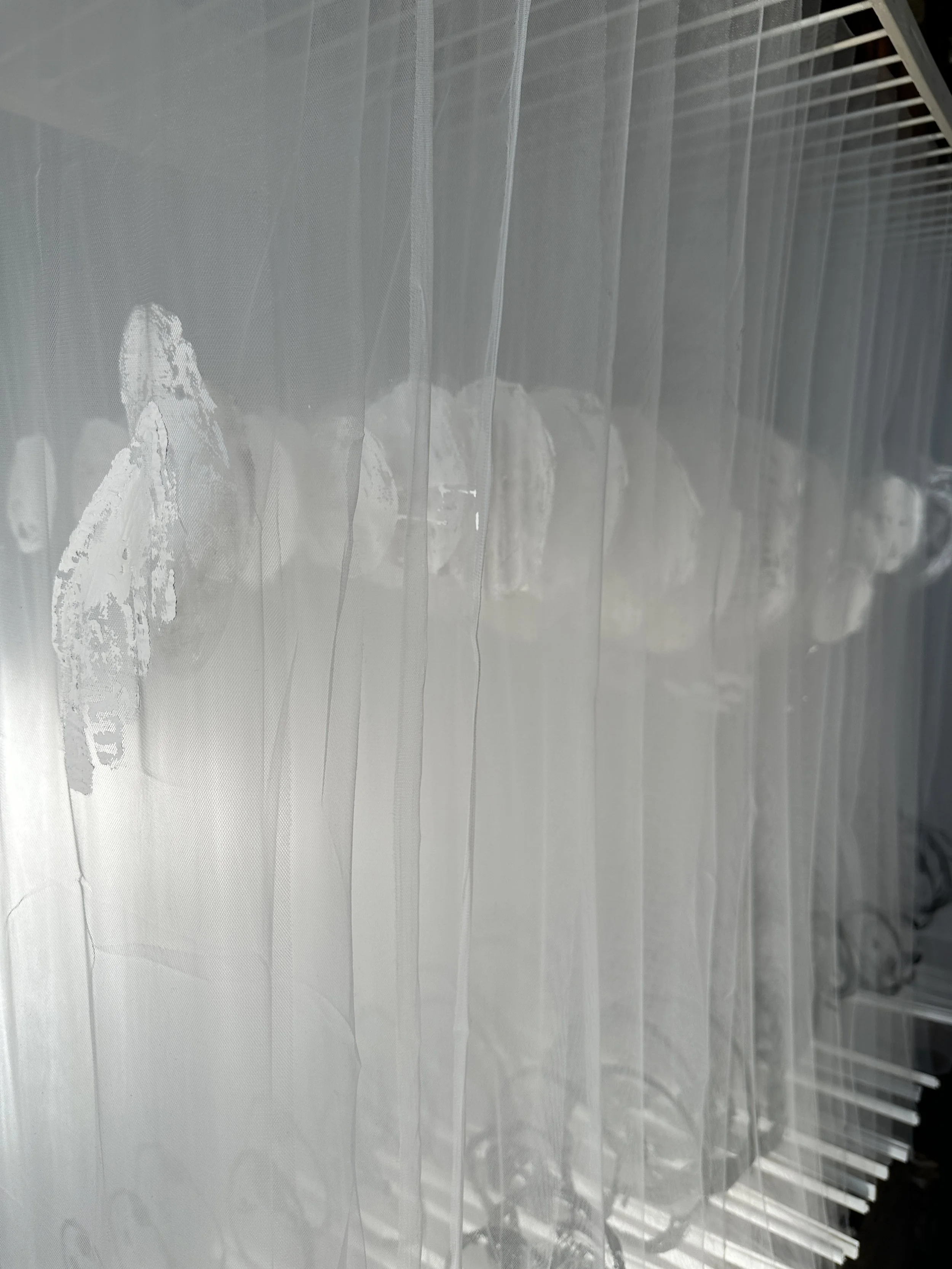
FIG. 1, FIG.2
Chiffon, wood, dye, metal rods, resin, acrylic paint
243.84 X 121.92 x 86.36 (96 x 48 x 34 in)
Two human forms are suspended on parallel planes of chiffon.
The upper body is rendered in pale pigment.
The lower body is rendered in dark pigment.
Both are incomplete when viewed from any single angle.
Full legibility requires movement.
Air alters their alignment.
Distance fluctuates.
Contact does not occur.
One figure appears to rise.
One appears to settle.
The structure holding them remains fixed.
The bodies do not.
Gravity is present in both directions.
The meat knows freedom comes only when the dirt wins.
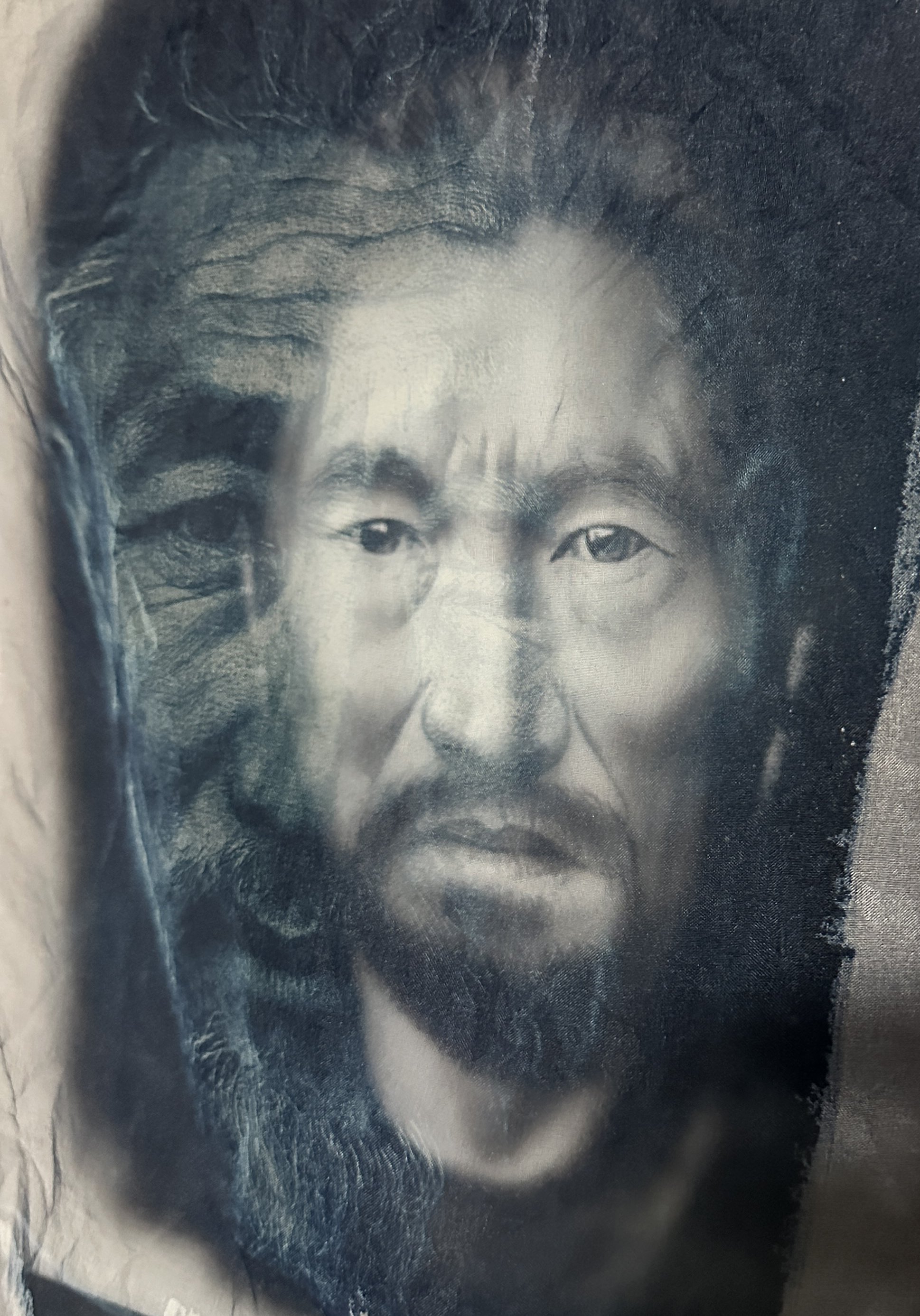
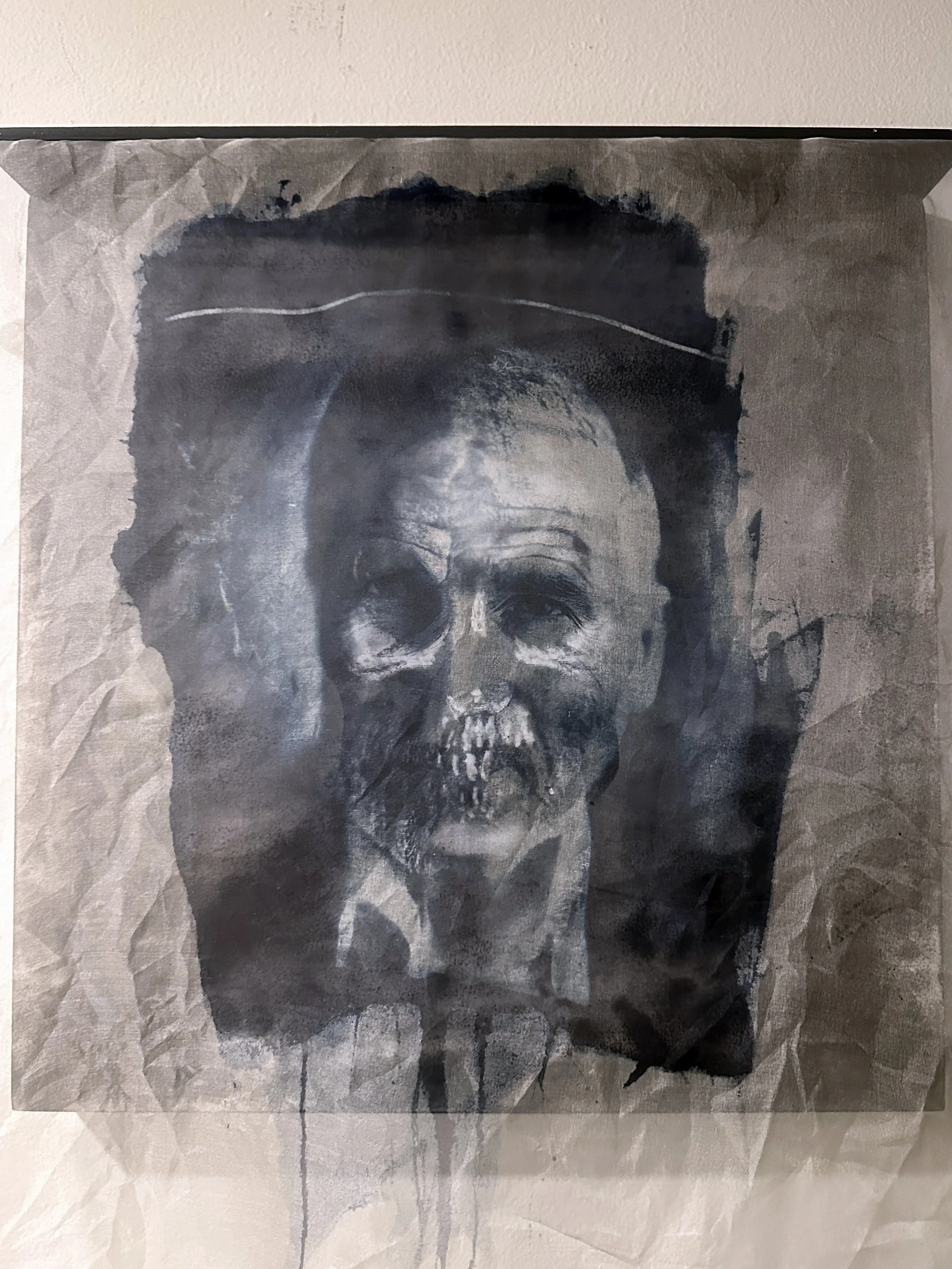
Fig 06-A (Young) Fig 06-B (Aged) subject: Carl
silk, cyanotype, silver point, graphite, acrylic paint, wood
35.56 x 35.56 cm (14 x 14 in)
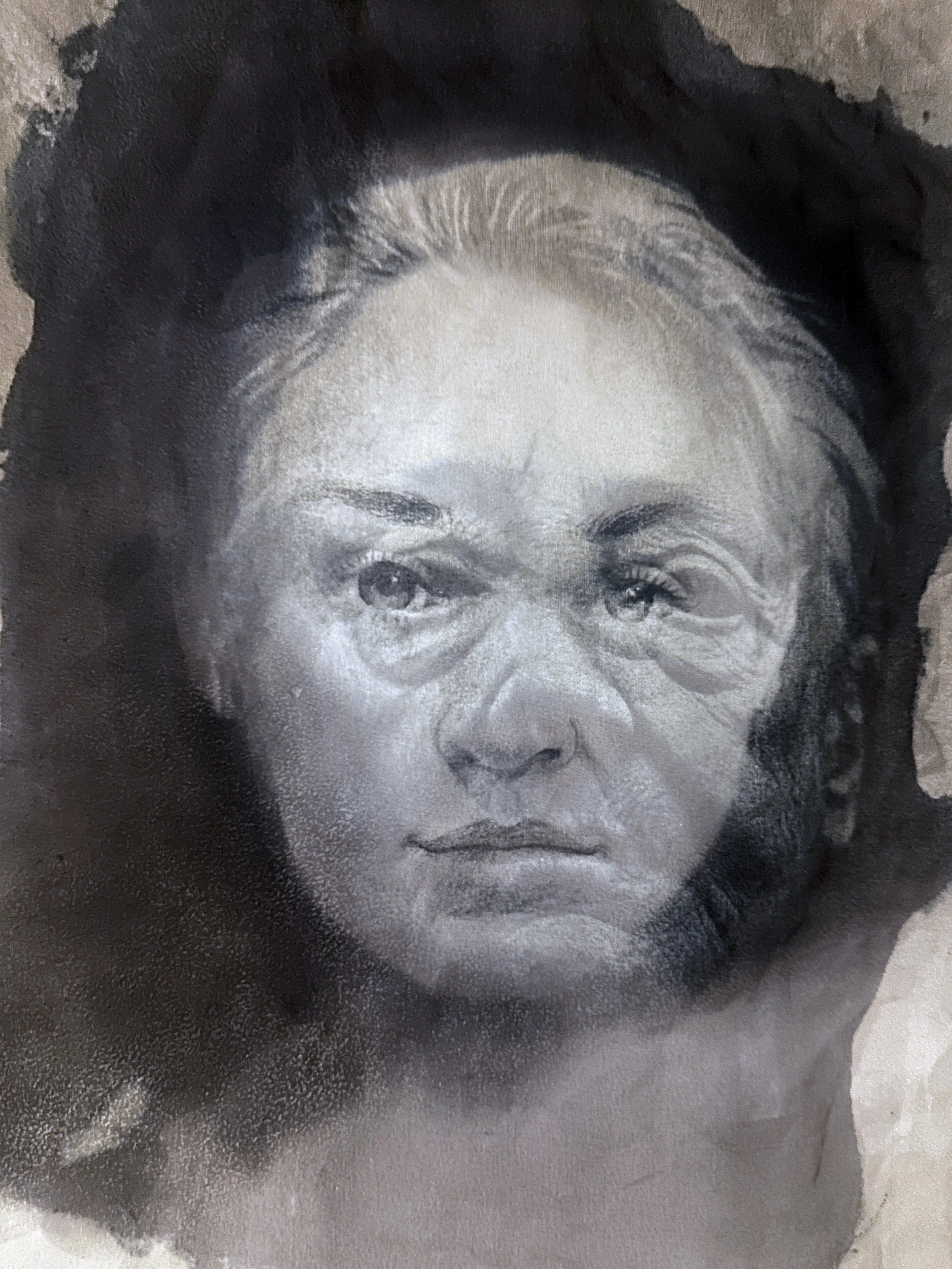
Fig 027-A (Young) Fig 027-B (Aged) Subject: Racheal
silk, cyanotype, silver point, graphite, acrylic paint, wood
35.56 x 35.56 cm (14 x 14 in)
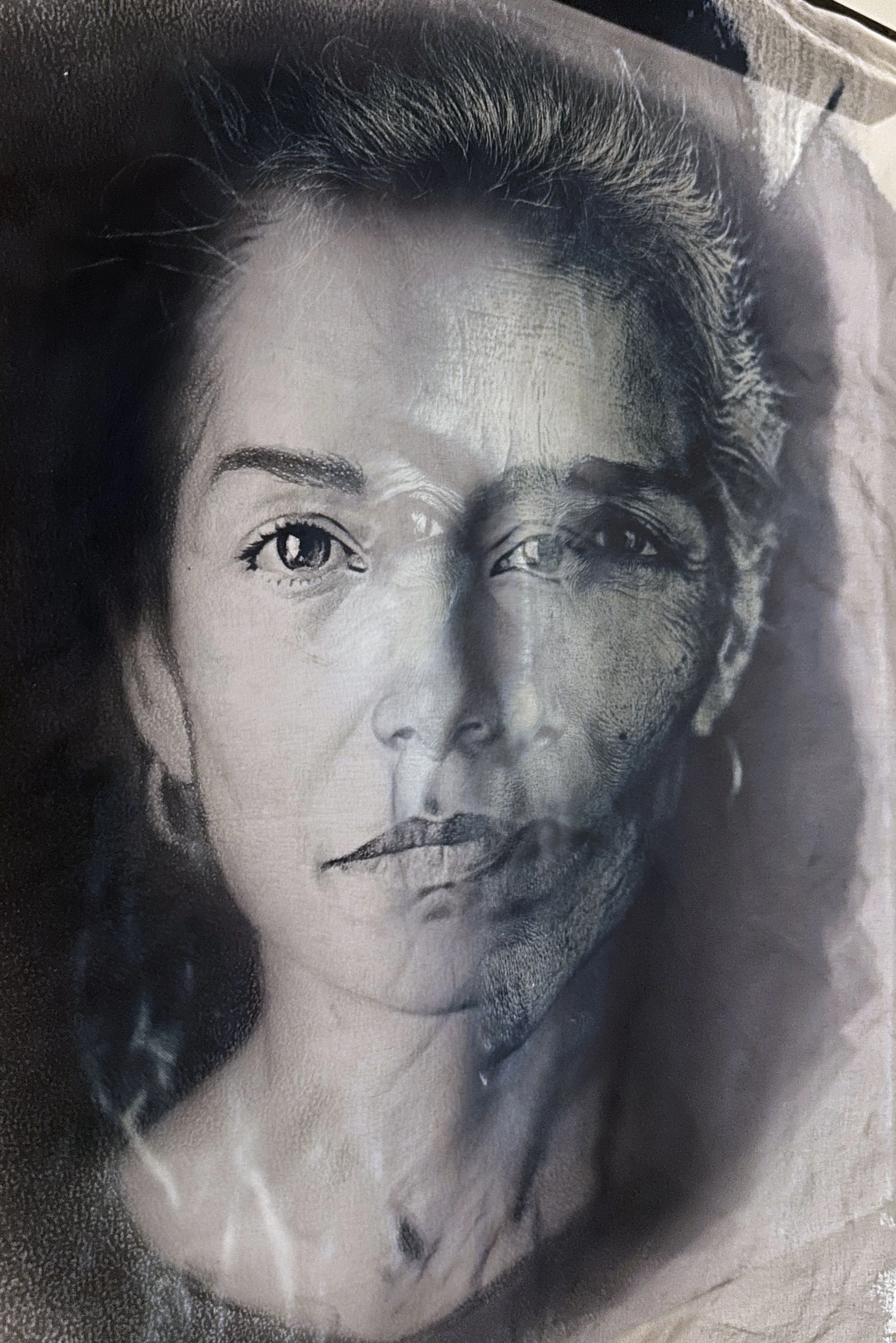
Fig 014-A (Young) Fig 014-B (Aged)subject: Sam
silk, cyanotype, silver point, graphite, acrylic paint, wood
35.56 x 35.56 cm (14 x 14 in)
Fig 038-A (Young) Fig 038-B (Aged) subject: John
silk, cyanotype, silver point, graphite, acrylic paint, wood
35.56 x 35.56 cm (14 x 14 in)
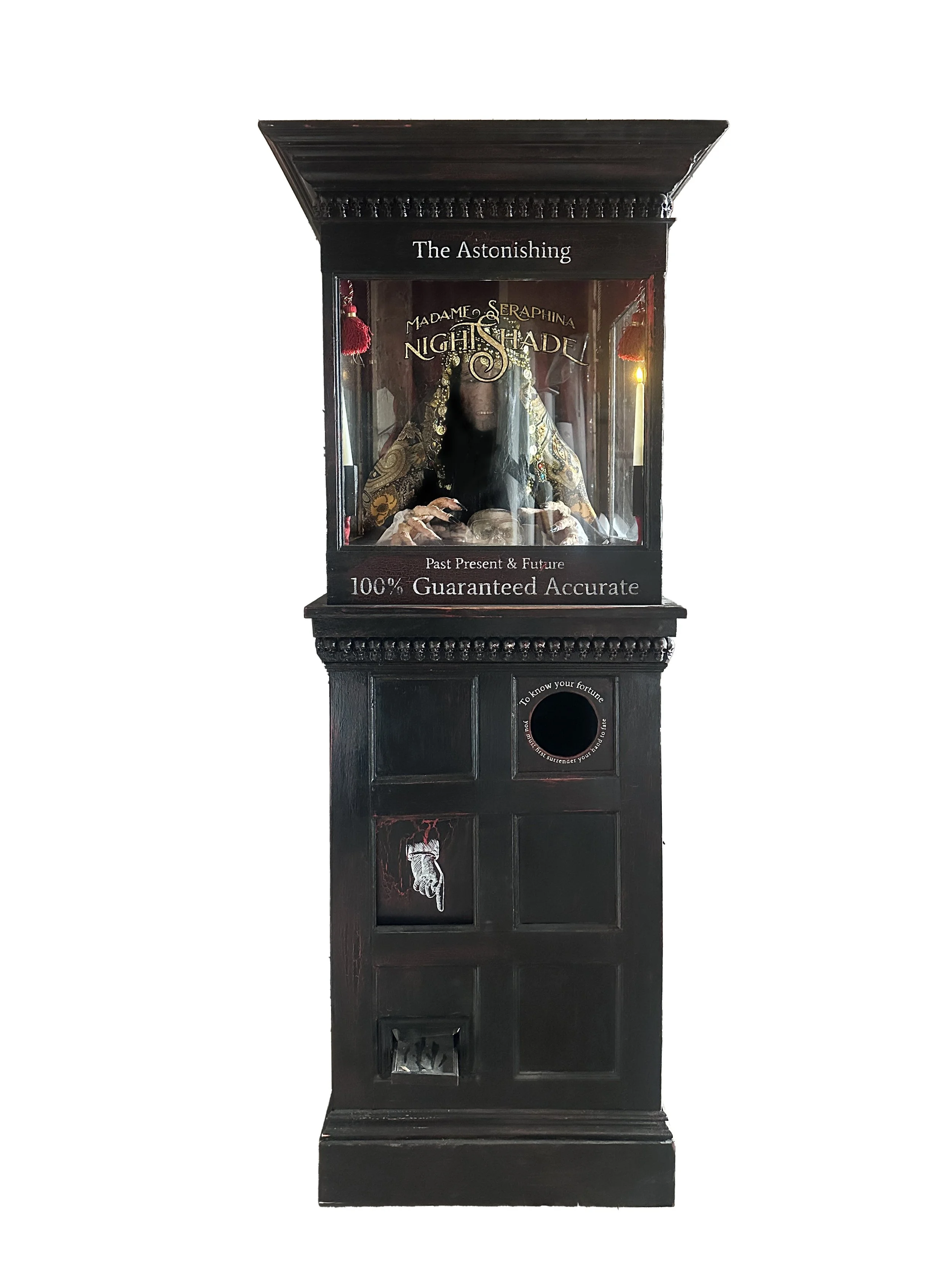
Madame Seraphina Nightshade
Mixed media installation
181.102 H x 54.61 D x 60.96 W (71.3h x 21.5d x 24w in)
In collaboration with Justin Ramsden
This is your future
It is everyone and everything’s future
For the living must die
What do you see when the past stares back at you, and how do you face the inevitable when it’s presented as a cold truth?
A relic of bygone carnivals, Madame Seraphina stands as a specter from a forgotten era. Her animated gaze offers not fortune but a cold reminder of the inescapable fate shared by all. As visitors approach, her head tilts and swivels, eyes darting with a lifelike eeriness, and her mouth opens and closes, offering a glimpse into the mechanical soul within. With each movement, she draws the viewer deeper into her unsettling presence.
The card, bearing only this stark truth, links the viewer to an impersonal finality, ushered forward by the whir of her mechanical limbs. Beneath the veneer of the old-time carnival aesthetic, Madame Seraphina invites a confrontation with mortality. Her face, sculpted in silicone, remains frozen in a timeless expression, reflecting the silent inevitability that looms over us all. The QR code on the reverse side connects to her cryptic, digital presence, further emphasizing the stark dichotomy between the physical and virtual, between the human and the mechanical.
In this interactive piece, the viewer is not simply an observer but a participant in a fleeting moment of engagement with fate. Madame Seraphina’s message is not one of comfort, but of a reminder, delivered in the chilling embrace of nostalgia, that all things come to an end.
Inspired by the great automata of the past, this work merges invention and sculpture.
Beneath its theatrical exterior lies an eight-axis robotic system, fully self-designed and fabricated.
It is not a restoration or reproduction, but a contemporary machine constructed from an original design.
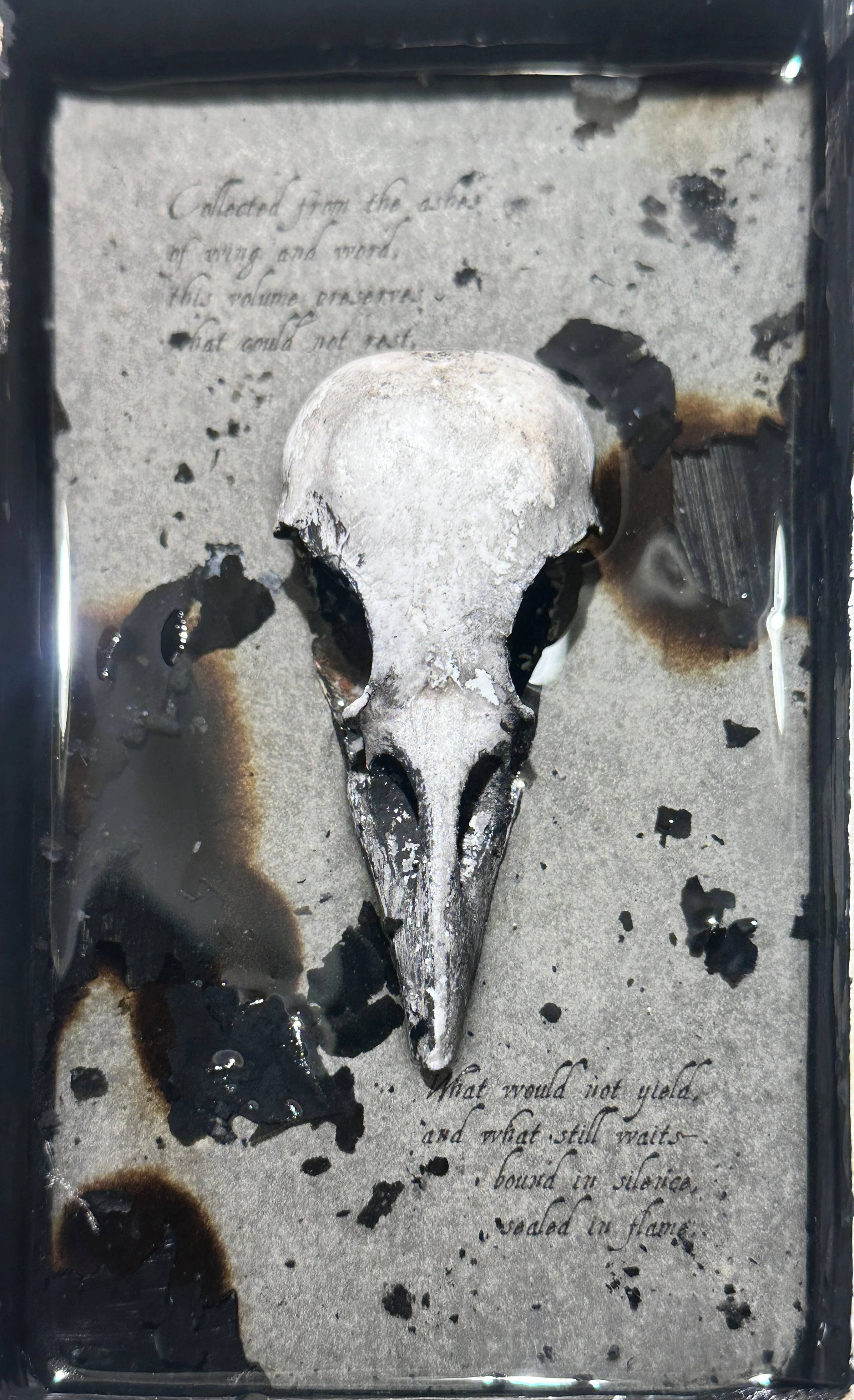
Firelight and Shadow: A Reliquary for Unquiet Things
Altered Book, ink, resin, oil paint, acrylic paint, plastic flies, crow feather, wood
21.59 x 15.24cm (8.5 x 6 in)
“Beneath the bone, a name unspoken. Beneath the name, a spell not yet broken.”
The sightless witness is sealed within a reliquary, locked in refusal at the hollowed core of a book. Cast in resin, the crow skull is surrounded by scattered remnants, ash from the removed pages, their words forever silenced. Beneath the skull is embedded a text drawn from imagined scripture and scorched myth, speaking to what burns inward: rage, memory, refusal.
The skull does not scream, but watches. The pages do not speak, but hold. What could not rest, could not yield, remains.
A monument to the fire that endures beneath stillness, preserving what the world tries to bury: grief, fury, and the fragile trace of flight.
A crow skull is sealed within the hollowed body of a book. Pages have been removed, burned, and compressed into residue.
The remaining text is fragmented and illegible, embedded rather than read. The skull does not perform as a symbol or a warning. It occupies a position of continued presence.
The object holds what could not be discarded. Refusal persists without declaration.
What remains is not speech, but containment.
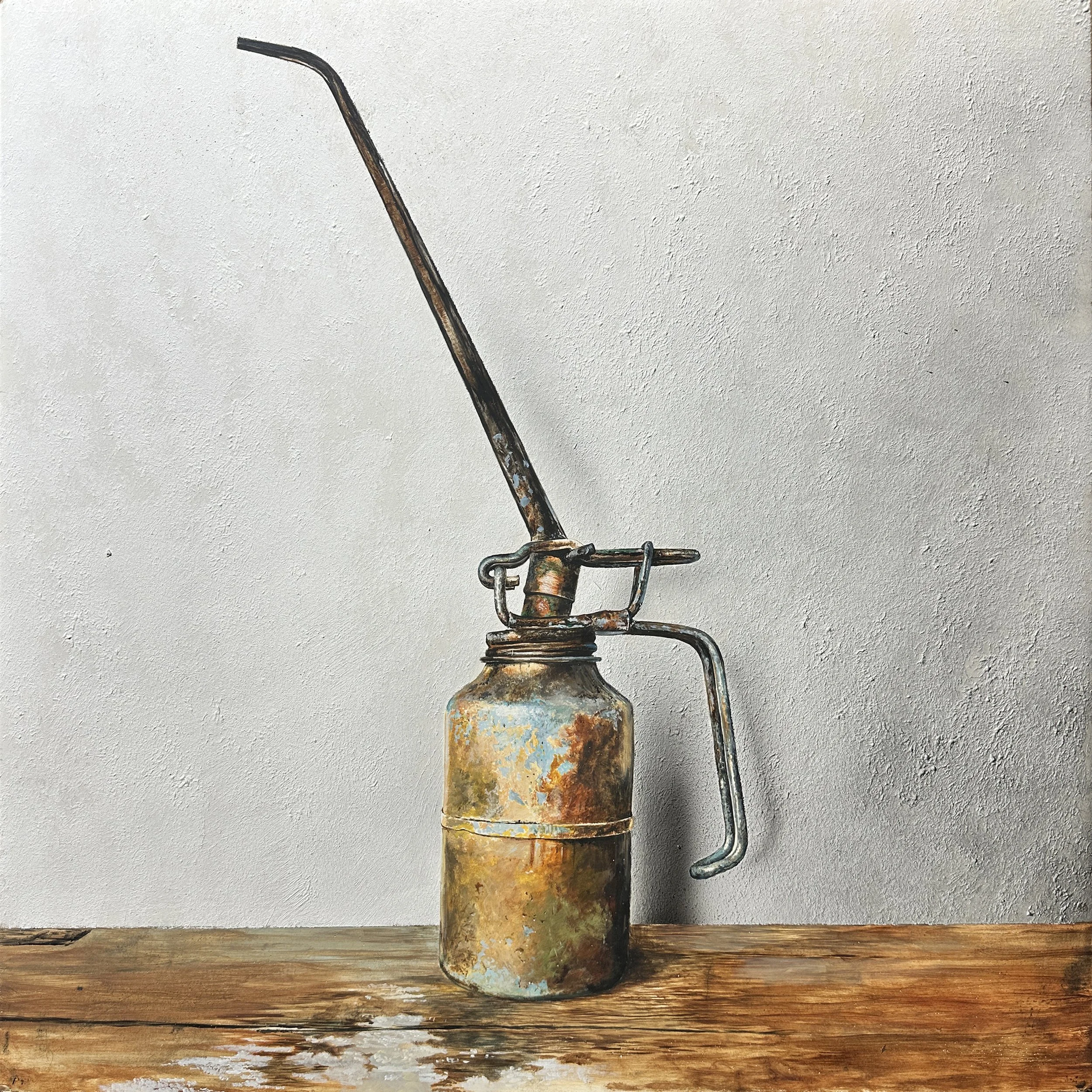
Worn in Service
Oil on cradled wood panel, framed in a shadowbox frame
50.8 × 50.8 cm (20 × 20 in)
A vessel designed to interrupt friction.
To extend function.
To delay failure.
The spout is dry. The body retains only residue, dark and persistent. The object no longer performs its task, but it continues to register having done so.
What remains is not motion, but maintenance. A record of attention applied quietly, repeatedly, and without recognition.
The can endures beyond usefulness, holding evidence of service rendered one careful gesture at a time.